Four Directions, Many Voices: The Enchanted Ecologies of Xochimilco
By Roberto Jones Romo and Mircea Lavaniegos Solares
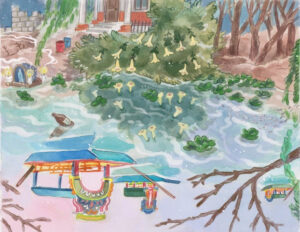
“Xochimilco” is an experimental work of speculative eco-magic surrealism that explores multispecies perception, ritual, mythology, and the entangled ecologies of the Xochimilco ecosystem. Moving among plants, animals, water, buildings, and discarded objects, its narrative asks what becomes perceptible when human experience ceases to organize the world.
Lake Xochimilco once formed part of the interconnected lake system of the Basin of Mexico. Its surviving canals and wetlands bear the traces of centuries of cultivation through chinampas: agricultural plots constructed from accumulated mud and vegetation, with trees such as the ahuejote helping to stabilize their edges. This landscape has been shaped through sustained relationships among water, soil, plants, and the communities who cultivate it.
During the nineteenth century, Xochimilco underwent an accelerated process of urbanization and was incorporated as an administrative district of Mexico City. Our essay does not seek to render invisible the presence of these manifestations of extractive capitalism in the region. On the contrary, we foreground the ways in which nonhuman beings endure and respond to the devastating effects caused by the use of fertilizers and pesticides, as well as by the contamination of surviving bodies of water in a megapolis. In this way, we seek to open a dialogue with the remaining flora and fauna of this lacustrine environment, which are currently threatened by the expansion of urban sprawl, extractivism, and mass tourism.
In response to this socio-environmental crisis, we adopt a posthuman perspective from which Xochimilco’s lacustrine landscape is conceived as a site where more-than-human discourses intersect—or, at the very least, where the human does not occupy a central position. Through a sensory exploration and the use of relational language, we appeal to a latent wisdom residing in the movements of water, in the memory of architecture, and in the exchanges among the various living beings who inhabit the region: plants, insects, birds, fish, mammals, and amphibians, but also organic and industrial materials, as well as human-made objects that have forgotten their former owners. The hierarchical systems that have historically privileged humans over animals and plants are unsettled, making way for a landscape densely populated by voices calling for the regeneration of life, immersed in a process of incessant transformation to which humans, too, are summoned.
In this experiment, which explores the interconnectedness of Xochimilco’s diverse inhabitants, humans are the last to be invited to a concert they neither composed nor conduct. What appears inert begins to stir and tremble when approached with a sensibility attuned to its heteroglossia: a multiplicity of expressions conveyed through aromas, textures, movements, gazes, and temperatures. Through an intuitive science, we converse with plants through smell, with water through movement, with insects through sight, with the gods through temperature, until even the bubbles rising from the depths of the lake become vessels of forgotten voices.
Yet this polyphony also reveals the contradictions of a landscape in which living beings are cultivated, contained, and transformed into commodities according to the demands of mass production. Rather than separating the natural from the artificial, these encounters expose their continuous entanglement, inviting us to reconsider the systems through which humans have sought to exploit and control the living world. In attending to these more-than-human exchanges, we side with an ethics of reciprocity grounded not in human stewardship, but in the recognition that bodies, technologies, and environments participate in processes of mutual transformation.
As scholars of the study of the esoteric, we are interested in the intersections between Neoplatonic imaginaries and Amerindian worldviews. Hence, in this piece, we draw on the fictional framework of a spiritualist séance, such as those practiced in Mexico since the mid-nineteenth century. Rather than seeking communication with the spirits of the deceased, our séance invites the reader to encounter the voices and desires of nonhuman beings inhabiting the landscape of Xochimilco. Plants and the “spirits” of insects communicate through writing, images, and gestures, composing a mysterious language reminiscent of the sounds and knockings associated with the earliest Spiritualist phenomena that emerged in the United States and subsequently spread throughout the world. In this way, the cempasúchil flower, commonly placed in Mexico on altars during the Day of the Dead, assumes a dual role: it is both an enchanted offering and a medium that preserves, within its petals, the traces of a longed-for reunion.
In turn, we propose a journey through the four cardinal directions, inspired by a contemporary interpretation of Nahua cosmology and the calendrical accounts preserved in pre-Columbian and colonial codices, particularly the Codex Fejérváry-Mayer. Within this cosmological framework, the terrestrial world is organized around four directions and a sacred center, each associated with particular deities, colors, calendrical signs, and relationships between human and nonhuman existence. Rather than reproducing these associations as a fixed system, our narrative reimagines them through the trajectories of nonhuman actors inhabiting the ecological and spiritual landscape of Xochimilco.
In Mictlampa, the northern region associated with Mictlan, the realm of the dead, and deities such as Mictlantecuhtli (god of the underworld and the dead) and Tezcatlipoca (god of the night, sorcery, and destiny), the plants convene a séance, invoking ancestral memory and the continuity between life, death, and decomposition.
In Huitztlampa, the southern “region of thorns,” associated with Huitzilopochtli (god of war, the sun, and the Mexica people), discarded objects perform their dance across the lake, while the waters struggle against contamination, transforming the cosmological struggle to sustain life into an ecological confrontation with human waste.
In Cihuatlampa, the western “region of women,” where the sun descends and the Cihuateteo (divinized spirits of women who died in childbirth) were believed to dwell, the narrative moves to the Island of the Dolls. Here, the conversations of abandoned toys planted on a chinampa bring Nahua female divinities into dialogue with contemporary popular rituals and questions concerning the origins and transformations of religious belief.
Finally, in Tlahuiztlampa, the eastern direction of dawn and the rising sun, associated in different traditions with Tonatiuh (god of the sun), Xipe Totec (god of renewal, agricultural regeneration, and transformation), and Tláloc (god of rain, water, and agricultural fertility), the journey concludes with the axolotl. Its remarkable capacity for bodily regeneration becomes an invitation to reconsider reciprocity among living beings, the waters of Xochimilco, and the processes of decay and renewal through which ecological life continually transforms.
Throughout the narrative, plants and animals are identified by their scientific names and, whenever possible, by the names through which they are known in Mexican Spanish. Similarly, the ecological landscape of Xochimilco is interwoven with the mythical geography of Nahua cosmology, where the Five Suns, preserved in codices and Mexica stone carvings, continue to cast their heat upon the present. Through this encounter between different ways of knowing and inhabiting the world, we call for a renewed science grounded in the holistic cultivation of life, one that recognizes the agency of nonhuman beings and the inseparability of bodies, technologies, and environments. Such a science would not seek to conquer nature or overcome death, but to learn from the processes of decomposition, regeneration, and transformation through which life continually remakes itself. After all, the dead are never entirely absent from the living: they persist in the water, the soil, the roots, and the bodies of those who come after them. Perhaps the first step toward imagining another future is learning to listen to the worlds that have never stopped speaking.
#
Roberto Jones Romo is a Mexico City-born writer and researcher whose work explores the intersections of contemporary art, esotericism, and the critical posthumanities. Currently pursuing a dual PhD at the National Autonomous University of Mexico (UNAM) and the University of Groningen, his research examines how aesthetic, symbolic, and spiritual practices challenge conventional understandings of the human and their relationship to the world. His writing moves between academic inquiry and literary experimentation, exploring the entanglements of memory, mythology, materiality, and the more-than-human world.
Mircea Gerardo Lavaniegos Solares is a Mexican literary scholar and researcher specializing in Western esotericism, comparative literature, and the intersections of art, religion, and spirituality. He is currently pursuing a PhD in Literature at the National Autonomous University of Mexico (UNAM), where his research explores the influence of esoteric traditions on modern literature, artistic expression, and cultural thought. His interdisciplinary approach examines how myth, symbolism, and the imagination shape literary and artistic representations of the sacred, revealing the enduring presence of esoteric traditions in modern cultural expression.
Counterpoint blogs may be reprinted with the following acknowledgement: “This article was published by Counterpoint Navigating Knowledge on 2 November 2026.” The views and opinions expressed on this website, in its publications, and in comments made in response to the site and publications are those of the author(s) and do not necessarily reflect the views and opinions of Counterpoint: Navigating Knowledge, its founders, its staff, or any agent or institution affiliated with it, nor those of the institution(s) with which the author is affiliated. Counterpoint exists to promote vigorous debate within and across knowledge systems and therefore publishes a wide variety of views and opinions in the interests of open conversation and dialogue.
Image credits: “Xochimilco,” watercolor © Sandra Lavaniegos García (@melocotonki), 2026. Used with permission.



0 Comments