Ode to the Undomesticated: Twenty Years of Encounter
I was at a crossroads—trying to discern which of two different life pathways I might follow—so I hiked into woods I knew well, settling at the most remote point on the trail to sit with my indecision. The day was quiet. Birds called. I was lost in thought.
Then, without having seen it arrive, a bobcat was simply there. Close enough to startle me. It wasn’t agitated or on guard. It just sat, patient and present, looking directly at me.
Bobcats avoid humans. This one didn’t. I was jarred at first, then curious. I found myself wondering if this was something more than a chance encounter—a sign, perhaps. A messenger. Something trying to speak to me in a moment when I desperately needed guidance.
Then it was gone. I never even saw it leave.
The honest truth: I wanted that meeting to mean something. I was seeking some cosmic sign to resolve my uncertainty. It didn’t. The bobcat divulged no secrets, offered no wisdom about which path to take.
But that encounter stuck with me.
The Unresolvable Encounter
Later, it dawned on me that the cat was wild, and whatever meaning I desired was just a projection. It remained, stubbornly, simply itself. The bobcat was a lesson in alterity: others have their own purposes, mysteries beyond my categories. Some encounters simply can’t be resolved.
A friend told me it must be a “spiritual” experience (whatever that was). Something not gathered from institutions, but a genuine encounter with otherness I couldn’t explain. I don’t know if that was a fitting term for it, but the memory of the cat lingered.
Years later, reading about animism and nature spirituality, I found language about encounter with other-than-human persons, and imagined that, indeed, I had once encountered a bobcat person!
This and other wild experiences pulled me toward graduate programs in religious studies where I could approach such questions empirically, as phenomena open to description and explanation, not just frothy emotional appeal.
When I began graduate work, I discovered I wasn’t alone.
Scholars across disciplines had been documenting how people generate religious meaning through encounters with nature and non-human others through practices outside institutional religion. When I found the doctoral program in Religion and Nature at the University of Florida, I knew where I needed to be.
Finding the Others
So, when I found myself huddled over Bron Taylor’s dining room table, proofreading galleys of the Encyclopedia of Religion and Nature, I felt less like I was helping with an academic project and more like I’d finally found my people. The Encyclopedia substantively treated the global religions, but it was also taking seriously religious cultural production that fell outside their confines. Encounters with nature, non-human beings, ecosystems, wilderness, and weather were also sites where religious meaning-making happened—not reducible to private psychology or sentiment, but forms of human behavior open to analysis and investigation.
The Encyclopedia’s power was in gathering these voices, legitimizing these questions, saying: yes, this matters. But the Encyclopedia was a project, not a community. The momentum it created raised an obvious follow-up question: what if we made this an ongoing conversation? What if we built an academic membership society dedicated to this work?
In 2005 we decided it was worth a try. Taylor and his graduate students (me among them) engineered a small gathering in Cocoa Beach, Florida. Present were some of the scholars who would shape what the Society became: Laurel Kearns from Drew University, who’s mentored many as the field grew and diversified; Whitney Bauman, now President-Elect of the Society; Joseph Witt, later editor-in-chief of the JSRNC; Kristina Tiedje, an anthropologist then at the University of Lyon, bringing years of work with Indigenous communities; and Laura Hobgood from Southwestern University, now a former President of ISSRNC and a long-time leader in the religion and animals orbit.
By the end of that meeting, we agreed the time for such a community had come. In the years that followed, the Society did more than gather scholars. It helped constitute a field—giving scattered work a shared vocabulary, a journal, conferences, and an intellectual community in which new questions could take root.
What the Society Made Possible
Over twenty years, the ISSRNC has become what we hoped: a place where openness to difference energizes scholarship. It is a community in which work that exceeds traditional disciplinary boundaries has a bonafide scholarly audience.
For some members, that openness begins in encounters with non-human nature (like bobcat persons). For others, it comes through Indigenous knowledge traditions, feminist and queer studies, and other decolonizing modes of knowledge production that challenge the presumed universality of Western academic categories. For others, it is found in the proliferation of contemporary spiritual practices—everything from meditation and drum circles to the revival of traditional lifeways after centuries of suppression. For still others, it emerges through contact with disciplines radically different from their own: realizing that an urban activist thinks about nature in ways a philosopher never considered, or discovering that an anthropologist studying Shinto ritual practices is raising questions a biblical scholar has never asked.
What unites us is recognizing that such encounters—with nature, across difference, through new lenses—crack open our categories and generate knowledge we didn’t know we needed.
I remember paddling Ichetucknee Springs with scholars from different disciplines discussing ethics while birding. At Cocoa Beach, I watched Bill Jordan bouncing about in waves during his first surfing lesson in Tropical Storm Ophelia. I walked the streets of Amsterdam with scholars from four countries pontificating on public transportation.
These moments mattered because they brought us into real contact across difference—not performing agreement, not reading papers to empty conference rooms, but having genuine conversations that changed how each of us saw our own work. That’s what drives the Society: the knowledge that emerges when we listen to narratives our disciplinary assumptions might otherwise flatten or miss.
Why This Matters Now
In the United States and elsewhere, the institutions that preserve and produce knowledge are under mounting pressure. Research funding is being slashed; climate scholarship and public education have become targets of political intervention; Indigenous languages and knowledge traditions remain vulnerable to erasure. Meanwhile, environmental devastation accelerates.
This is when communities like ours matter most—preserving room for questions that might otherwise be dismissed as marginal.
We do this work by staying engaged with one another across disciplines, bringing our students into the conversation, doing research that pushes us into unfamiliar territory, and remaining willing to be changed by what we find there.
I never learned, of course, whether that bobcat was some sort of spiritual messenger or simply a wild creature with unusual tolerance for human proximity. I’ve decided the distinction doesn’t matter much. The encounter mattered not because it resolved my uncertainty but because it changed how I understood it: otherness was not a problem to solve or force into existing categories, but something whose significance might lie precisely in exceeding them.
For me, that is what the ISSRNC represents: a community of scholars willing to follow questions that do not fit conventional boxes—willing to listen when other fields reveal what our own have failed to see. Twenty years in, we are still discovering what our training has taught us to miss, and still building a community willing to be changed by what it encounters.
This blog post is the eighth, and last, in a series about the history of the ISSRNC. In preparation for the ISSRNC’s 20th-anniversary conference in Venice in October 2026, all of the association’s former presidents will share their experiences and insights.
#
Lucas F. Johnston is Professor of Religion and Environment at Wake Forest University. His research explores sustainability-oriented social movements and environmental politics, the religious dimensions of secular social movements, and place-based pedagogy. He is the author of Religion and Sustainability: Social Movements and the Politics of the Environment (2013) and Key Thinkers in Religion and Environment (2024), and the editor or co-editor of three additional volumes. Johnston is currently President of the International Society for the Study of Religion, Nature, and Culture (ISSRNC).
Counterpoint blogs may be reprinted with the following acknowledgement: “This article was published by Counterpoint Navigating Knowledge on 12 September 2026.” The views and opinions expressed on this website, in its publications, and in comments made in response to the site and publications are those of the author(s) and do not necessarily reflect the views and opinions of Counterpoint: Navigating Knowledge, its founders, its staff, or any agent or institution affiliated with it, nor those of the institution(s) with which the author is affiliated. Counterpoint exists to promote vigorous debate within and across knowledge systems and therefore publishes a wide variety of views and opinions in the interests of open conversation and dialogue.
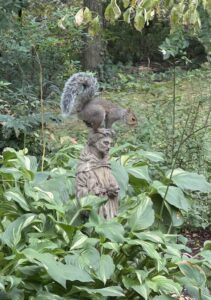
Image credits: “Canticle of the Squirrel,” photo © by Lucas F. Johnston.



0 Comments