A Philosopher and 300 Religious Studies Scholars Walk into a Bar
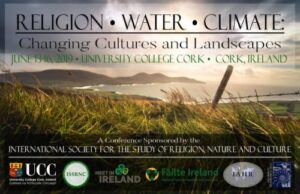
I’ve been involved with the International Society for the Study of Religion, Nature, and Culture (ISSRNC) almost from the start, beginning with the old membership committee, a handful of presentations, helping out with conference organizing, and five years as treasurer. I was lucky to be vice president under Sarah Pike’s leadership before serving as president from 2018–2021, which included our conferences in Cork and the Covid-era online conference with Arizona State University. Since moving off the board I’ve been a co-editor for the Journal for the Study of Religion, Nature, and Culture.
All of this was fun, but nothing was more fascinating than being an eccentric philosopher lurking within a society of religious studies scholars.
My own scholarship began in Hegel’s naturphilosophie with excursions into Kierkegaard and Marx and that whole crowd. However, it was my colleague Jim Cheney who nudged me into looking at the theoretical difficulties underlying what was then becoming environmental ethics. In the early 90’s I became a speaker on radical environmentalism (social ecology, deep ecology, and ecofeminism) for the Wisconsin Institute for Peace and Conflict Studies—which is how I met Bron Taylor, then a displaced surfer from California living on the shores of Lake Winnebago with an office at the University of Wisconsin, Oshkosh. At the time we were both living a real-life version of Joel from the TV show Northern Exposure.
We hit it off.
I wrote about five of the Encyclopedia of Religion and Nature entries and, after returning from a sabbatical year in Riga, accompanied Bron to the EarthFirst! Rendezvous in Trujillo Meadows, Colorado, when he was scheduled to interview Ted “The Unabomber” Kaczynski. I told the full story a few years ago at the ISSRNC’s New School conference. After about 5 days up on the Continental Divide, I came down with high altitude pulmonary edema and was evacuated down to Chama, New Mexico. It was a pretty exciting experience, but Bron got me home in one piece … which shouldn’t surprise anyone who knows Bron.
After that I was drafted into the society. The ISSRNC was a perfect fit for my eclectic interests—something true for most of our members over these years. Welcoming all points of view, what Bron called “the ongoing conversation” in his opening blog for the ISSRNC President’s series, has been the overwhelming strength of the society. But I’d like to make an additional case for the wonder (and fun) that this ongoing conversation produces.
When the ISSRNC Board held its strategic planning session at Arcosante, Arizona, back in January 2017, we kept asking ourselves the fundamental question any strategic planning requires: why anyone would want to be a member of the ISSRNC?
There are, of course, a million perfectly good reasons why any scholar in an interdisciplinary field like this would want to join—but here’s an important lesson I took from Marshall Ganz’s community organizing courses:
You can’t organize around a good idea. You have to organize around a passion—and the ISSRNC has one.
We thought back to what most characterized our conferences and apart from the obvious things like a fascinating diversity of topics and a commitment to rigor in argument and methodology, the thing that stood out most was that our members really enjoyed the conferences. Really. A lot. The conferences uniformly and predictably sparked joy and wonder and fun for everyone.
If I can crib from Plato here, our conferences have always provided the opportunity for the best kind of conversation with your friends—which, at this stage of my career, is now the only definition of philosophy I’m interested in. Turns out that’s been true for most of our members.
The way our society explores the nexus of religion, nature, and culture produces wonder and joy. The examples arrive in a swarm of happy reflections, not only from the conference papers and publications, but in conversations outside of the formal sessions. Two moments in particular come racing back to mind: one was Mary Keller’s paper at the Cork conference where she asked us to take demons seriously (brilliant and fun and provocative); and the other happened some years earlier at the Malibu conference when I mentioned, quite casually, to David Haberman that I needed to explore the Bhagavad Gita more carefully before including it in my introduction to religious studies course. Sitting out beside the fountain at Pepperdine, David gave me a 2-hour master class in Sanskrit puns and an entirely new insight into this classic work.
Moments like this happen all the time at our conferences. Surprises that lead to insight and wonder.
And there you have it. I used to do a lot more deep-thought-thinking about how societies can work best for members, support new scholars, help graduate students enter their careers, and provide a forum for innovation and cross fertilization but, more and more, I keep going back to the original texts in my discipline, for insight. Like this one:
Aristotle pointed out that wonder is what provides us with access to the arche, to the architecture of the universe. I trust and hope that all of our ISSRNC members will continue to generate and enjoy the sense of wonder they’ve created by stepping boldly into the surf where religion, nature, and culture hit the shoreline of their scholarship.
This blog post is the fifth in a series about the history of the ISSRNC. In preparation for the ISSRNC’s 20th-anniversary conference in Venice in October 2026, all of the association’s former presidents will share their experiences and insights.
#
Mark C.E. Peterson is Emeritus Professor of Philosophy and Religious Studies at the University of Wisconsin-Milwaukee. He began his career focused on 19th-century continental philosophy, including Kierkegaard and Marx, but especially Hegel’s natural philosophy and the history of science and technology. These interests eventually constellated around the project of explicating the personal and cultural presuppositions in our scientific, philosophical, and spiritual relationship to nature.
Counterpoint blogs may be reprinted with the following acknowledgement: “This article was published by Counterpoint Navigating Knowledge on 21 July 2026.” The views and opinions expressed on this website, in its publications, and in comments made in response to the site and publications are those of the author(s) and do not necessarily reflect the views and opinions of Counterpoint: Navigating Knowledge, its founders, its staff, or any agent or institution affiliated with it, nor those of the institution(s) with which the author is affiliated. Counterpoint exists to promote vigorous debate within and across knowledge systems and therefore publishes a wide variety of views and opinions in the interests of open conversation and dialogue.
Image credits: Poster of the 2019 ISSRNC Conference in Cork.



3 Comments
A Philosopher and 300 Religious Studies Scholars Walk into a Bar – International Society for the Study of Religion, Nature, and Culture (ISSRNC) · July 21, 2026 at 4:31 PM
[…] article was published by Counterpoint Navigating Knowledge on 21 July […]
Tempus Fugit: Monarchs, Mentors, and Mysteries - Counterpoint: Navigating Knowledge · August 13, 2026 at 8:24 AM
[…] ISSRNC president Mark Peterson, in his recent Counterpoint blog, captures how the Society, in its exploration of the religion, nature, culture nexus, “produces […]
Tempus Fugit: Monarchs, Mentors, and Mysteries – International Society for the Study of Religion, Nature, and Culture (ISSRNC) · August 24, 2026 at 1:45 PM
[…] ISSRNC president Mark Peterson, in his recent Counterpoint blog, captures how the Society, in its exploration of the religion, nature, culture nexus, “produces […]