Finnfaring Today: A Creolizing Strategy for Ontological Decolonization
Download a free PDF version of this article (19.7 MB).
Abstract
This article is a piece of auto-anthropology that reflects on creolization as a way of producing ontological decolonization and re-engaging ancestral relations by actively seeking the Other. I have adapted the medieval Scandinavian concept finnfara (faring to the Sámi) into the contemporary English term finnfaring, i.e. the quest to meet and engage a cultural Other as a method for Animist knowledge development. These reflections are based on my own experience as a Euro-descended person working to recover Euro-traditional knowledge by learning from the methodologies of Afro-Brazilian religion. Based on Yoruba knowledge tradition, Afro-Brazilians have created their Orisha cult, Candomblé, as “safeguarded” spaces in modernity. In these spaces they apply creolizing and trickster interpretations to keep alive technologies of dividuation, constructing or manifesting gods based on an immanent ontology. This article considers an example of transferring Afro-Atlantic dividuation technologies to Northern European polytheism and applying these to resisting hegemonic modern epistemology. This suggests the possibility of dividuating Nordic deities with technologies of the orisha- and nkisi- traditions, practicing Asa-Candomblé.
1. The Gitksan Yunnan Incident
In August 2006, a theater group from the Gitksan First Nation travelled to Yunnan, China, to participate in the International Forum on Ethnic Minorities.[1] The group was part of a cultural project that had struggled to revive the remains of traditional mask rituals. However, something extraordinary happened in China, which profoundly empowered their struggle to reclaim their religious culture. In Yunnan, the group encountered and interacted with representatives of a Chinese ethnicity who were similar to themselves in a number of ways. This encounter appeared to have spurred some form of deep cultural synergy. As they were walking through the streets of Yunnan in a procession with other Indigenous groups representing their cultures, the raven trickster suddenly returned to his people. This other-than-human person possessed one of the dancers, made fun of a Chinese police officer, and behaved in the generally disorderly and provocative manner typical of Raven. This occurrence hailed the reinvigoration of the Gitksan masking tradition. Dreams containing instructions on how to make specific masks started returning to the group, and these masks were no longer only figures associated with traditional lifestyle, but they also reflected the contemporary world. One mask was “Camera” (Reine Guédon 2011).
A comparable meeting with the Other as a motor for ontological decolonization is the topic of this article and I will examine it in terms of the pre-Christian Scandinavian concept finnfara, adapted to contemporary English finnfaring. The medieval concept means going to the Other, in this case the Sámi (Old Norse: finnar), as a method to build religious knowledge.
This article is a piece of auto-anthropology on my own finnfaring, my experience learning from Afro-Atlantic religions as the path to re-engage Nordic polytheism. I see this experience as a possible strategy for successfully reclaiming or reinventing ancestral religiosity. But before getting into this, some remarks concerning cultural property and exchange have to be made.
As a white racialized majority person and member of a slave-trading nation, my immersion in Afro-Atlantic spirituality is not without problems. Clarifying my thoughts on cultural property would be an article of its own, so here I will just outline my main thoughts. First, different kinds of culture are owned in very different ways. Words, for instance, are not property in the same way as, say, knowledge of a Candomblé initiation, which is the topic of this text.[2] The ownership over Candomblé initiatory knowledge is also different from intellectual property in current academia, which is affirmed by being disseminated (and properly referenced). It is also different from the kind of ownership attached to identity markers, i.e., being owned by an identity group. Candomblé knowledge is transmitted through initiation where the ownership lies with communities of knowledge keepers. My working thesis is that David Graeber might be right that ownership as such—not just cultural ownership—is somehow related to sacrality (Graeber & Wengrow 2023, 180–185). I further believe that some tensions around ownership arise when sacrality is transferred onto identity as in contemporary ideologies that enshrine and valorize identity. For instance, some might choose to see orisha/nkisi traditions as black identity property, because these religions have been spaces of cultural resilience for enslaved Africans. I don’t see it as my place to oppose this, nor do I wish to. But if that position would be applied to ethically challenge my initiation as a white person, this challenge would actually only target me secondarily. Primarily it would target the line of initiation, its knowledge keepers, and their management of a body of knowledge which they certainly own. Such a challenge would also be ethically problematic, so there is an unresolved tension, a paradox. My working solution to this paradox is threefold:
- I suggest a “staying with the trouble” (Donna Haraway) attitude where we don’t try to resolve the tension between black identity ownership and white participation. We need space for both black identity empowerment and white decolonization through cultural exchange as ethically legitimate, even though they might conflict at some points.
- I have striven to be very vocal about my deep and authentic appreciation for the cultural accomplishment of afro-diasporic religion.
- Though I have communicated a lot in the public, I have held the specific story of initiation somewhat in the background in order to not accentuate the tension.
I hope this will suffice as an ethical basis for which to consider the fact of a white person going through Afro-diasporic initiation.
This article rests not only on my own finnfaring, but also on my research based on New Animist theory to understand how creolization is applied in Candomblé construction of deities, called dividuation (Hjarnø Rasmussen 2019). Dividuation is the process by which gods or spirits are made manifest through relation-making such as ritual engagement (Bird-David 1999, 72; 75; 77). Using this theoretical framework brings us well beyond any essentialist and totalizing notions of a coherent religion based on a distant imagined past that may lurk in the attempt to reengage pre-Christian European polytheisms. I want to theorize finnfaring as an active practice of cultural encounter for the purpose of maintaining dividuation, creating a kind of ontological safe space, a ritual space that is not characterized by that “separatist agenda” that Graham Harvey observes as a defining feature of modernity: spaces dominated by a hegemony of “deanimating matter and disembodying minds” (Harvey 2018, 36; 41; 49). In Candomblé, however, this ontology is held at bay. And I believe that is necessary for a dividuation of spirits and gods with a level of intensity and reliability comparable to what is found in Afro-Brazilian cults of the orisha and nkisi deities.
I will describe my own finnfaring, the religious development whereby I approached Nordic religiosity by moving through a space of Other, Candomblé, but where this Otherness became a path toward ancestral traditional knowledge and animating technologies of my own ancestors. I will pose this as a viable alternative to the Pagan religiosity conceptualized as a distant, imagined “religion” that I sometimes encounter among devotees of contemporary Nordic polytheism, for whom religion is conceptualized as a static museum object. This leads me to shift the focus from historical precision to effective dividuation of ancestral other-than-humans, and I suggest finnfaring as a viable strategy to achieve this.
I pose this consideration against the backdrop of a discussion of what is sometimes called the “reconstructionist” program in the form advocated by Bil Linzie (Linzie 2004; 2014). If functional relating to Nordic other-than-humans is to be achieved, then the notions of culture that underlie this project need to be updated to a point where creolization and cultural mixing are recognized as fundamental to the reinvention of Nordic polytheism. In my own case this finnfaring culminated in my initiation as a Candomblé possession priest of Odin[3] through different Afro-Atlantic ritual technologies of dividuation. Finally, I will reflect on the viability of contemporary finnfaring and learning from Afro-Atlantic strategies for ontological decolonization.
2. Reconstructionism
Attempts to re-imagine Nordic polytheism are often based on medievalist literary scholarship and archeology. This implies focus on source criticism, identifying and looking beyond the Christian bias of the medieval written sources. The scholarly project is mirrored in the ways that contemporary Heathens work to reclaim Nordic polytheism under the banner of “reconstructionism.” I will not explore this trend in depth (Calico 2018; Schnurbein 2017), but will take as my starting point the work of Bil Linzie, a very influential founding figure of North American Heathenry, which is considered representative of the reconstructionist trend (Nordvig 2020, 19). Though this position has likely taken many forms since Linzie, I still find his launch of this religious project to be relevant and representative of reconstructionism. Linzie formulates his religion with a foundational metaphor that is somewhat surprising:
Ásatrú is a reconstructionist religion. In a sense, Ásatrú is to ancient Germanic religion what the Living History Museum at Williamsburg, VA is to colonial American life. The attempt is to recreate as closely as possible what the religious philosophical and moral mind-sets of the ancient northern and/or western Germanic individual. (Linzie 2014, 7)
He uses the metaphor of a museum object as the ideal image of his religion. Changes to this “museum religion,” which Linzie locates in Scandinavia in the period 350 CE to 1180 CE, are distortions that pose a threat to the purity of this museum religion (Linzie 2014, 3; 7):
[F]oreignisms, either knowingly or unknowingly brought into Ásatrú are distortions of the overall worldview. Some of these distortions are great and some are small but they remain distortions nevertheless. The reader might well view these additions as being akin to bringing a Dremel tool into the woodwright’s shop at the Living History museum. (Linzie 2014, 8)
Linzie works from a static, totalizing notion of culture, in which “the social mores, legal systems, art, favorite colors, folk music, religion, and stereotypical customs are all expressions of the same world view” (Linzie 2014, 10). However, most contemporary scholarship works from the idea that creolization or “foreignisms” are central to how culture is generated (e.g. Eriksen 2003; Hannerz 1992; Cohen 2007). In fact, some contemporary scholarship suggests seeing animist culture specifically as relationally rather than systemically defined (Handelman 2008, 182; Pedersen 2014, 178; 179; Espírito Santo 2016, 89; 100; 102).
This totalizing notion of culture permeated by a single coherent worldview in which an object such as “a religion” can be attained also has a serious problem from the emic perspective. If pre-Christian Northern European culture is one consistent, coherent machinery of interdependent meanings to whose “worldview” the contemporary Asa-devotee is aspiring, then exactly what are we buying? Setting aside puerile fantasies of adventurous Vikings, who would then want to internalize a worldview that was the driving motor of a slavocratic class society, entrenched in tribal war, ruled by sacred kings and where human sacrifices like the one described by Ibn Fadlan is an act of meaningful religious devotion?[4] To be fair, Linzie does not advocate for any of this, but the totalizing notion of a consistent “culture” nevertheless forces him into a defense of Iron-Age caste society as somehow an unavoidable “natural” state of affairs (Linzie 2014, 14 ff.).
However, Linzie’s metaphor that exemplifies the distortion of his pristine culture is interesting. It is the contemporary electric woodworking machine, the Dremel tool, which appears misplaced in the “living history museum” (Linzie 2014, 8). This contemporary electric tool is of course a very concrete improvement of the workshop functionality, as long as we assume that the woodshop is meant for woodworking and not just a nostalgic pastiche of an imagined past. I therefore adopt the image of the Dremel tool as a positive metaphor for the kind of “foreignist” finnfaring method that I suggest. A method that does not focus on a systemic worldview, but on concrete improvement and functionality of animist technologies.
In the following I will describe my own use of two such Dremel tools. The first is New Animist theory, which can teach us to understand the nature of deities and spirits. The second is the concrete experience of Afro-Atlantic counter-modernity as a form of ontological decolonization, which can successfully create spaces where the epistemological preconditions for engaging other-than-human beings is possible, also on the premises of modern urban life.
3. First Dremel Tool—Animist Theory
Contemporary New Animist theory shifts perspective from a bounded, well-ordered world system to organic relation-making (Pedersen 2014, 178; 179; Espírito Santo 2016, 89; 100; 102). It is a post-Cartesian understanding of religion with significant consequences, because it practices ontological symmetry between the scholar and the “native” (Latour 2005, 76; Viveiros de Castro 2015). This imparts a dynamic and realistic understanding of gods and spirits as fully valid, subjective actors and partakers of reality (e.g. Descola & Palsson 1996; Kohn 2013). If gods and spirits are real agents (which we co-construct), then focus moves away from the modern conceptual object, “the religion,” and onto concrete practices of relating to other-than-humans. Against this background, it makes sense to ask how we might functionally create relations with ancestral deities.
The Brazilian anthropologist Eduardo Viveiros de Castro has suggested perspectivism as a cornerstone of an Animist ontology. When you perceive something, this perception implies that it becomes a someone perceiving you back (Viveiros de Castro 1998). Subjectivity is an inherent quality of perception, which is condensed in networks of relating. For example, the Inuit have an all-important relation with the sea, so the Sea Mother as a provider condenses as the subjectivity of Inuit perception of the sea (Laugrand & Oosten 2010). This implies that she is a real personal agent in Inuit reality, and can be placated, contacted, communicated with through dreams and ritual practice.
The Israeli anthropologist Nurit Bird-David focuses on subjectivity as dependent on relating. She calls this dividuality, relational subjectivity, which is brought into being through dividuation (Bird-David 1999). What we call religion typically contains technologies that manage these relational subjectivities, or “dividuals.” For instance, through rituals. Rituals might be seen as tools of dividuation. Practitioners of West African or Afro-Atlantic religion consciously understand themselves as active participants in those ritual dividuation processes that bring other-than-humans into being through relating (Barber 1981; Goldman 2009a; Bird-David 1999, 71; 72). As we shall see, this constructive attitude to non-human subjects plays a central role in the Afro-Brazilian religion Candomblé. Candomblé practitioners consciously understand their deities as co-constructed by humans who tinker (as Goldman phrases it) deities into being through technologies of masking, drumming, dancing, costuming, butchering, cooking, fetish making, and language (Goldman 2007, 114; Sansi 2007; 2009, 149; 2011b, 279). To candomblistas, religion is the way in which humans manage and co-construct other-than-human subjectivity.
4. Second Dremel Tool—Finnfaring
The background for my use of the concept of finnfaring is a medieval Nordic notion of attaining religious knowledge by seeking the Other, specifically seeking the Sámi (old norse: finnar). This is indicated by Medieval Norwegian laws that contain bans on intercultural activities such as:
Trúa á finna (believing in the Sámi);
Fara til finna (visiting the Sámi);
Fara til Finnmerkr (visiting Sápmi, the Sámi lands);
Fara til Finnmerkr at spyrja spá (visiting Sápmi to gain prophecy);
Gera finnfara (to do finnfaring).
(Strömbäck 1935, 204)
Dag Strömbäck sees this as reflecting a deeply rooted practice from Heathen times of learning sorcery with the Sámi (Strömbäck 1935, 204). This apparent valorization of Sámi/Nordic knowledge exchange may be reflected in the indications of cultural exchange between Sámi and other Nordic peoples thoroughly treated in research history (Hultkranz 2001; Price 2002; Rydving 1990; Strömbäck 1935; Zachrisson 1998). I will not go into detail with this interesting topic, just mention that there are possible similarities in the culture of shamanic divinatory drumming, and a Sámi ritual described in the Vatnsdæla Saga seems highly reminiscent of a seiðr ritual described in Eiriks Saga Rauða (Price 2002, 72; Tolley 2016). Though it is difficult to say conclusively what these similarities show, they do make sense in the context of Nordic people visiting the Sámi specifically for religious knowledge. This knowledge exchange rests on a Nordic valorization of the Sámi as an iconic and religiously charged Other. Else Mundahl suggests that Norwegian kings worked from a metaphor of kinship between Norwegians and Sámi as genealogies struggled to position Sámi descent in those saga narratives that legitimized their claim to Norway (Mundal 2009; 1996). Mundal suggests a parallelism between the Sámi and the jǫtnar (forces representing the outside social), where Norwegian kings marrying Sámi women are a human parallel to the common mythological intermarriage between gods and the jǫtnar (ibid).
The motif of the Sámi as quintessential Other has had a remarkable endurance in Scandinavian cultures. As far south as Denmark, folk legend remembers a troll named Finn, and the medieval expression finvitka (Sámi sorcery) seems somewhat related to the term Lapperier (Sámi stuff) as a name for sorcery (Tang Kristensen 1895, vol. III, 181–94; Mundal 1996, 112). Through time, however, this othering has also served more sinister purposes, such as legitimizing colonial oppression of the Sámi. During the witch hunts in Norway, the idea of the Sámi as religiously charged Other served to legitimize the murder of Sámi noaidit, religious experts (Hagen & Alm 2020). The stereotype of the Sámi sorcerer even attained some international currency (Shumkin 1996). And stereotypical imagery has cast the Sámi as personifications of the wilderness in iconic children’s tales, like Elsa Beskow’s “Olle’s Ski trip” (1907) and H.C. Andersen “The Snow Queen” (1844).
Here, however, the point is the friendly or even kinship-based pre-Christian Otherness in producing animist relation. The American phenomenologist Thomas Csordas suggests that the attraction to the Other or “alterity” is a fundamental motor driving the genesis of religion (Csordas 2004; 2007). This is reflected in the way that many religious contexts seem to conceptualize motifs from “far away” as religiously charged (e.g. Partridge 2004). The idea of the Sámi as Other is this kind of an idea, and my suggestion is to apply finnfaring as a generic term for approaching alterity in order to produce religious knowledge. In principle, finnfaring can be carried out in any religious system perceived as Other, but I suspect that contexts with a strong iconic otherness are particularly functional. Afro-Atlantic religions have historically been the targets of strong Othering, even in ways that mirror modernist Othering of European traditional perspectives. An example is the construction of the concept of “fetishism” as the defining savage Other to modernity (Ciekawy 1998; Meyer & Pels 2003; Pels 1998; Sansi 2007; Shaw 1997). Afro-Brazilian immanent dividuation technology is an example of the kind of culture that has been labeled “fetishistic,” and this is where my own finnfaring went.
5. My Finnfaring into Candomblé
In my youth, I leaned toward Nordic polytheism in my personal religiosity, but over time this didn’t yield much religious experience for me—nobody seemed to be listening, and the combination of Harry Potter gear and nationalist leanings did not inspire much interest in me. After a period exploring the thinking of the mystic and philosopher Erwin Neutzsky-Wulff, my practice of the Brazilian martial art capoeira brought me in contact with the Afro-Brazilian religion Candomblé, which seemed a viable candidate for a powerful contemporary humanist polytheism.
5.1. Candomblé
Afro-Atlantic religions are, from modern perspectives, often the ultimate Other if anything. Since the Haitian Vodou religion played a part in ousting the French regime in Saint Domingue and founding the free republic of Haiti, African religions have been stereotyped as demonic (Laguerre 1989). This stereotype has not failed to attract young seekers such as myself, and at times this attention does not bode substantial changes in the stereotype of Otherness ascribed to the African religions (Hjarnø Rasmussen 2019, 45). But the global attraction that Afro-Atlantic religions exert on Euro-descendants cannot be reduced to racist exotifying. These are religions that are similar in many ways to pre-Christian European religions, and they are knowledge systems with a unique capacity for responding to modernity (Graeber 2005). They tend to spread through “cognitive bridges,” meaning stepping-stone worldviews that lead people toward this apparently alien religious experience (Frigerio 2004, 4). In many parts of Latin America, popular Catholicism and Spiritism play this role of religions with strong ties to modalities of cult of the orisha/nkisi-pantheon, and there are examples to suggest that in post-Protestant Northern Europe, occultism might serve a similar function.[5] The bottom-line is that the orisha/nkisi-cult is today a strong global religion (sometimes labelled a “world religion”), which is making inroads among Euro-descendants also in Europe itself (Capone & Argyriadis 2011; Olupọna & Rey 2008).
Candomblé is an initiatory cult of possession with core elements from West Africa and Central Africa. There are even ties to European folk beliefs, Christianity, and Spiritism (Bastide 1978, 304; Engler 2016, 204; Capone 2010, Loc. 836). It is a religion that might be classified as what Philippe Descola and Marshall Sahlins label hierarchical animisms, meaning that it is centered on cosmocratic gods (Descola 2014, 202; Sahlins 2018). In Brazil, Candomblé works almost like a polytheistic framework that combines and absorbs elements to produce a ritual technology that can manifest divinities from distant cultures, such as Yoruba and Ba-Kongo. It has always struck me as a good bid for how Asa/Vanir devotion might have looked, had it survived until today. European observers have long had an uncanny sense of cultural familiarity toward the iconically othered African polytheism (Graeber 2005, 413 ff.; Hjarnø Rasmussen 2019, 43).
5.2. My Story
I practiced devotion to orishas for years, lighting candles and praying to them, understanding specific deities as important to me and consulting the cowrie oracle for advice in spiritual matters. According to Candomblé, every person is the son/daughter of one primary orisha, a second one, which is also important to the person, and sometimes even a third. Each orisha has certain characteristics, and they are said to be indicative of the personality of a person. People in Candomblé settings constantly relate your behavior to the pantheon. If you are behaving flirtatiously, people will remark that perhaps you are really the son of Xangô. If you got yourself out of a difficult situation in the street, they might say that Exú is strong with you, etc. Many have complex spiritual biographies where their spiritual relations evolve and change with new oracular answers from different temples (Hjarnø Rasmussen 2019, 96ff.). Deities step in and out, are reinterpreted, change origin, and even cross between “religions” (Hjarnø Rasmussen 2019, 189ff.). In initiation, however, the situation for each initiate is settled for good and one primary set of relations is manifested.
For many years, I had practiced Candomblé identifying as a son of the hunter god Oxóssi and of Iansã, the storm goddess. A group of old friends from the occult milieu in Denmark had started to practice Candomblé, and a couple of them had become initiated in Brazil. One of them started developing the so-called ebori ritual, a ritual to link a person to a protective spirit, what the Yoruba call an óri, comparable to the Norse fylgja. I went through this ritual in the summer of 2013 and kept a keen eye out in my dreams for indications of my main god Oxóssi and possible signs of initiation. I had moved to Uppsala to begin my Ph.D. research on Candomblé and would soon travel to Brazil, where I expected that I might be initiated. My first signs of trance experience had already manifested. But something else happened. My dreams manifested that Nordic religious language that I had left as a young man. Here is a dream I recorded not long after my first ebori:
I was with a group of rather hectic Viking warriors. One of them was an old but powerful one-eyed man [sic!]. He had grey beard and long hair coming out under his helmet and we were supposed to fight a duel with axes. The reason for the duel was unclear. There was a situation where I suggested that the duel be fought with some reeds of some sort [??], so it would be symbolic in some sense. But an authority overseeing the duel denied this. We were supposed to give everything for honor [??]. We fought behind my family’s farmhouse in Jutland and behind him was a dark grey sky with lightning as he was yielding his long-shafted Dane axe. It was fairly certain that he would strike me down, and he did indeed force me to the ground somehow. And at the point where he was about to kill me, I fell into trance and lay in front of him. In the dream I saw this from the outside. But as I lay there, I understood that the fact that I had given myself like that—for honor—meant that I had given myself to his god Odin. And as I came round, I said in old norse “Faðir min” (my father)!, and he answered “son min” (my son).
(Dream with Odin – 5/7/2013)
At the time I had this dream, it was mostly unclear. I was firmly steeped in orisha conceptualization and did not pay much attention to Nordic symbolism. But both the metaphor of parenthood and the motif of being killed are clear indicators of the main spiritual relation in Candomblé, so when I recounted the dream, the man who was later to initiate me immediately said that perhaps it wasn’t Oxóssi but Odin who wanted me for initiation. The thought was alien and unsettling to me. The 16 orisha of Brazilian Candomblé had become my frame of supernatural orientation, and everything seemed well planned. Typical of Candomblé practitioners seeking life-sustainable ways of being close to the resource-heavy religion, I had gotten a Ph.D., and I would now be able to do research, while possibly going through initiation into the religion. Everything was perfectly laid out, and having to face up to the conglomerate of nationalist ethno-nostalgia, horrid Viking romanticism, imagined 9th-century costumes, and the rest of Heathendom’s infights and idiosyncrasies was not high on my wish list. So, I went to Brazil and studied Candomblé while my dreams steadily overflowed with runes and ritual directions for how to invoke the æsir.
5.3. Initiation
My initiator is a Danish/Inuit man with university background in computer studies, linguistics, and cultural studies, where he focused on Inuit shamanism. He has worked linguistically with Chukotko-Kamchatkan and proto-Inuit-Yupik languages. However, his frequency of supernatural experiences and contact with other-than-human subjects posed a threat to his psychic health, and he found a way in reading the Danish mystic Erwin Neutszky-Wulff about whose writings popular opinion holds that they will either make you crazy or keep you from going crazy (Thejls 2010). However, his Neutzsky-Wulff-based work with Inuit material did not give him any accountability, and he experienced what he describes as “shaman sickness,” expressed as a constant carnival and uncontrollable running of weird spirits. He found accountability when he turned to Candomblé. Here he found a ritual technology that not only had an effect, but had the desired effect, and could be accounted for to consistently reproduce this desired effect. So, my friend, who is very pragmatic and not big on ethnicity, left the Inuit complex behind and became a Candomblé initiated in Brazil as a possession priest of the thunder god Xangô.
His background in computer studies and linguistics shapes the way he understands religion. Ritual is directed by a ritual “grammar,” and the associative operations resemble coding languages in the way semantic elements of information interlink and produce the desired outcome. He is not a charismatic cult leader but rather describes himself as misanthropic and extremely uncompromising. Making a version of Candomblé fit for contemporary Danes does not mean toning down the aspects that Danes might find difficult—rather the opposite. We have thick skulls, so in order to attain effective ritual technology, you need to hit harder and cut deeper (also in literal terms) to get through the skin of modernity-immersed North Europeans.
Today it is common to see secrecy as a mode of communication rather than an unambiguous ban on it (Sansi 2005, 143; Bateson & Bateson 2005, 87). In Candomblé, communication barriers are not only a fact of initiation but, rather, the cult can be seen as a complex system of establishing non-speaking, which serves the function of deconstructing standard language, establishing a secluded language space, and pressing knowledge from the objectifying verbal mode to more relational modes (Hjarnø Rasmussen 2019, 122ff.). Initiation is shielded behind a concentric system of communicative restrictions. It is the primary operation theater for producing and establishing the relation between a human and an other-than-human subject. Therefore, my communication on initiation is necessarily limited. However, I will describe the frame of the process just to give a bit of an idea of what Candomblé initiation is.
Candomblé is all about creating relation, but initiation is perhaps the prime example of Candomblé dividuation technology, where the primary relation is consolidated and fixed for life. An initiate is made into the bride of a deity, a iawo, which counts for any gender or sexuality, and which is why heteronormative social values sometimes make the process a problem for heterosexual men. So, Candomblé is considered feminizing, which was also the case of the Norse shamanic practice of seiðr that in the source material appears associated with the quality ergi, sometimes translated into “unmanliness.” In my case the complication was that it was a Nordic deity that wanted me for initiation, and even though a sizeable chunk of the best elder edda material (in my view) relates to Odinnic initiation, it is still next to nothing in comparison to the enormous mass of ritual competence and knowledge necessary to perform a functional initiation.
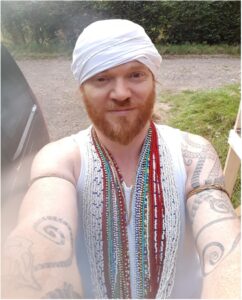
The author, Nordic Candomblé
It took us around two years to prepare my initiation. During the whole year before the initiation, I was constantly looking for and procuring the necessary elements, many of which were very difficult to find. Both my initiator and I were constantly recording dreams and mystical experiences with directions for the modifications necessary for Odin to manifest in this Afro-Brazilian ritual. Through reading and consultation with the information he gathered from mystical experience, my initiator had infused the Candomblé initiation with considerable elements of technology from the Cuban Paló religion, whose horrendous reputation occludes one of the most beautiful animist knowledge systems available in the Western hemisphere, a worldview in which everything is imbued with spirit and meaning that can be employed as the palero produces relational reality through complex technologies of associative semantic bricolage. The religious coding language of the ritual technology was defined and informed by many of the Odinnic motifs that had appeared in our dreams and studies. However, it was not possible to include all of them. Too much information was coming, and the requirements of the Candomblé dividuating technology also had to be respected.
Initiation is a long process during which the neophyte goes through many purifying rituals and is kept completely oblivious about what happens next. So, the initiate is isolated in a sacred space with the object that manifests the deity for weeks. Everything that happens to you comes a bit out of the blue, and it is often painful, humiliating, or both. The purpose is objectifying the initiate, so your subjectivity is bombarded from all sides by attacks on your sense of self, sense of adulthood, sense of gender, sense of physicality. Walking into the initiation room, I have never felt so profoundly pure, like a container of absolutely still mountain air. I also never thought that I would know exactly what it feels like to walk to your execution. This is more or less what I can say about that.
The core initiation process took three weeks of being submitted to objectifying ritual, that relation making technology intended to make me an muzenza possession priest of Odin. In order to return to a normal state of being, different taboos needed to be respected. Some are lifelong, some apply for a year, some for six months (like only wearing white clothes, not drinking alcohol, and avoiding cemeteries). The monetary cost of the whole process is probably close to 12.000 USD (app. 60.000 DKR), with both assistants and my initiator working pro-bono.
5.4. Lemba Odin
Before I was initiated, my initiator consulted the cowrie oracle to identify the orisha with which Odin would identify through the initiation. The answer was both surprising and obvious. Odin would dividuate through identification with Lembadile, a Bantu manifestation of the Yoruba-deity Oxaguiã, who in Brazil is identified as the warrior quality of Oxalá, the Allfather.
This operation between what we would normally name “religions” is not at all uncommon in Afro-Atlantic religiosity, where the agency of humans in co-producing divinity is fully acknowledged as a reality or perspective on reality that complements and interplays with the notion of gods as preexistent exterior beings (Barber 1981; Goldman 2009).
Candomblé deities are often multiplied into “qualities” (qualidades). These can be mixes between different orisha, like Yemanjá Ogunté, who is a Yemanjá, the goddess of the sea that shares some of her nature with the warrior Ogum. These qualities can also be trans-cultural, like Oxóssi Mutalambo. The Yoruba deity Oxóssi somehow inflected toward the Bantu Mutalambo, which is also sometimes identified directly as a Bantu parallel to Oxóssi.
It should be mentioned that the notion of gods as pre-existent is also a common language that serves other purposes of dividuation. Many Brazilians moving between Spiritism, Umbanda, and modalities of Candomblé seem to perceive these religions not as mutually exclusive coherent packages of belief, but rather as reservoirs of technology useful in relating deities. Deities often cross over between religions, for instance between Spiritism and Candomblé (Hjarnø Rasmussen 2019). Figures of a literary nature can cross over and become objects of active worship, and historically important humans can become identified with deities over time, as when historical kings of Ọ̀yọ́ and Ifé become orishas or a hero of the Haitian revolution identified with his main lwá (Dayan 1995, 28; Johnson 2011; Matory 2005b, 5).
It is possible that similar crossings between ritual complexes and groups of deities could have existed in pre-Christian Scandinavia. For instance, deities certainly seem to have crossed between cultural groups, so Sámi and Slavonic groups both have deities fairly closely related to Thor (Turville-Petre 1964, 96–98). As in Candomblé, there was quite an impressive array of different classes of other-than-human subjects (Price 2002, 55ff.). There are also a number of resemblances in social structure between sacred kingship in pre-colonial Yoruba society and Viking-age Scandinavia, but this is not the place to go into detail with this comparison (Pemberton & Afọlayan 1996; Russo 1978). I base myself, however, on the assumption that such similar religious systems rooted in similar social structures operate in ways that are at least somehow comparable. In any case, the inclusion of a new deity characteristic of a different ethnic group is certainly not foreign to Candomblé technology. As a polytheistic framework, Candomblé regularly includes deities even from distinct cultural categories such as Yoruba, Bantu, and Euro-Spiritism (Hjarnø Rasmussen 2019, 192ff.).
Brazilians deal with other-than-human subjects through relation rather than as elements inherently bound into a systemic “religion.” They do talk of religions, but the other-than-human subjects have a marked tendency to cross over between the Brazilian religions. A spirit guide encountered in Spiritism can follow a person into Umbanda, where it still receives cult and is then developed or dividuated into an aspect of an orisha if the person passes into Candomblé (Hjarnø Rasmussen 2019, 192ff.). Such transgressions are very common in Brazilian spirit biographies. During research in Brazil I interviewed the goddess Pomba Gira, manifest in a young man. The goddess described her transition process, which included several different cultural origins or “nations” (Hjarnø Rasmussen 2019, 159ff.).
So, once we take one small step away from the typically modernist way of seeing religion as mutually exclusive coherent monoliths, the identification of Lemba Odin is a rather common religious operation in the Afro-Brazilian way of operating. But this also implies that the match is by no means perfect. In the Eddic material, Odin still appears to have been constructed with certain characteristics, which in the Brazilian context are uncharacteristic of Oxalá/Oxaguiã and hence of Lemba. Odin has features that are very akin to the trickster Exú, such as his role as a seducer and poet, seen for instance in the Hávamál and his famous theft of the mead of poetry in the Skaldskapamál. Brazilians have constructed the trickster Exú with diabolic symbolism, which has put him in opposition to the Allfather Oxalá whose primary identification is Jesus. This opposition endures in Candomblé, where Oxalá-identified persons are supposed to keep a certain care and distance to the trickster Exú, who is often represented with diabolic imagery.[6] Yet, a certain close yet problematic relation does persist between the two deities.
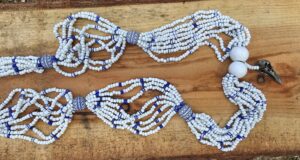
Of course, the concrete technology with which gods embodied in fetish-objects are produced is a deluge of concrete ritual details that activate the Odinnic motifs with the Afro-Atlantic dividuation technology. As the object of the initiation, I have been in the dark about most of this, and what I know is deeply secret. As an exoteric example, I can mention the ileké or bead strings that mark the identity of the orisha or nkisi deities. Each deity has a color code as a marker of their identity, and these colors are represented with beads. Red and black represent Exú, white and crimson red mark Xangô, transparent for the sea goddess Yemanjá, etc. I spent quite some time searching my dreams for answers on exactly what kind of color identification Odin would like. But I did not receive any clear answer. The color of corresponding orisha Oxalá is white, which symbolizes death and the transition to the other world, and the specific manifestation Lemba/Oxaguiã is white interspersed with light blue.
One possible color associated with Odin is the color blá (blue or black), which might represent death (like white, the color of bones, in some African contexts) (Lassen 2011, 156). It is the color of mourning, the color of corpses, and the color of the goddess of death, Hel (Cleasby & Vigfússon 1874). The end result became an adapted version of the Lemba beads (white with light blue). Lemba Odin is marked with beads that are white and dark blue.
The Ileké of Lemba Odin
However, this is just one example, and the concrete construction of this cult of Odin has only taken its very first small steps. More concrete technologies of manifestation and cult will be developed over time.
5.5. Exú Loki
The trickster Exú plays a part in Candomblé too central to be ignored. He is the mediator and threshold of all there is, the trickster dynamism that sets in motion everything from the creation of the world to any ritual performed in Candomblé. There is a specific Exú manifestation (a “slave”) linked to each god as the particular mediator of the deity. A similar system may be reflected in the fact that pre-Christian Nordic gods often have a servant who might serve mediating functions for the god.[7] During our process of gathering the necessary information, it was not completely clear to us exactly which manifestation of Exú would serve as the mediator for Lemba Odin. It would, however, make sense to manifest a Loki quality of Exú, as this trickster aspect would follow the Exúic logic of being essential in the (possibly) first manifestation of Nordic gods in this kind of technology. This was confirmed in dreams, so the Exú that opens for Lemba Odin is a modality of Exú named Exú Loke.[8]
These identifications could be verbalized in different ways. One could say that Loki is the basic other-than-human subject who is being dividuated through Candomblé technology. Another phrasing could perhaps be that Exú is being dividuated into contextually relevant motifs through his association with Loki. However, whether it is Loki being ritualized as Exú, or Exú identifying with Loki is perhaps not so existentially important (if the distinction even makes sense). The fact remains that the entity manifested is defined by the ritual fact of dividuating a Nordic deity through Afro-Atlantic technology. Loki and Exú are comparable trickster figures who share the vital characteristic of being cosmic first-movers. This appears more cosmically absolute for Exú, and perhaps more of a narrative motif for Loki, whom we know mainly through literary sources.
However, these figures also have differences. In the manner of Saturn, Satan, and other occidental tricksters, Loki is bound in a cave underground, and his emancipation heralds the collapse of the ordered world in the Ragnarok. Exú is much more present in normal social reality. He is still called “the slave” and thus is metaphorically bound, and it may have played a role that the West African cultures that he followed to the Americas were in fact enslaved. One could speculate that they did experience (and resisted) a fully manifest Ragnarok in the social and cultural cataclysm imposed on them by enslavement. Exú became the patron of all the interpretations and transfers of meaning that guard and uphold the spaces with which the descendants of enslaved Africans still maintain their animist technologies of relation. Exú’ic interpretations allowed orisha deities to be worshipped in the image of saints, and even the languages of modernity to be inverted, incorporated to protect the space of relational animist technology fundamental to the working of Candomblé (Hjarnø Rasmussen 2019, 167).
This contemporary other-than-human might surely be different in significant ways from what 10th-century Danes may have thought of Loki. The Brazilian Exú and the Nigerian Èṣù Elegbará have both become associated with the Christian devil, but the diabolic and cosmic Brazilian Exú is still a very important figure, as all dynamism rests on his initiative. Loki also has this role of first mover, and his creative and irreverent attitude to the gods is very like Exú. But he is also the motor in the breakdown of the Nordic cosmos. The chaotic forces that destroy the world are his children, he steers Naglfar toward the Ragnarok and fights Heimdal, a deity associated with cosmic order and things staying in their place.
However this may be, a relational thinking with religion shifts the focus toward successful dividuation of the other-than-human, rather than hypothetic prehistoric concepts that were relevant to—and contingent on—Iron Age reality. In fact, I would speculate that not being consistent with medieval Scandinavian beliefs and practices may be an advantage as this brings the practice of these deities into compatibility and alignment with contemporary contexts. The important thing is the relation, not speculative reflections of systemic coherence.
6. Where Does This Lead To?
In my research on Afro-Brazilian Candomblé, I have described the ways that practitioners of Afro-Atlantic religions maintain an animist perception and epistemology on the premises of contemporary urban modernity. In effect, they have figured out how to build ontologically decolonized spaces that counter the very modernity in our perception of reality (Hjarnø Rasmussen 2019). It would be too much for this essay to go into detail with the exact conceptual system that achieves this purpose, but it is worth noting that this positions Afro-Atlantic religiosity as a very strong contribution to global anti-colonialism, not only politically, but ontologically, as a strategy for what Eduardo Viveiros de Castro names “ontological self-determination” (Viveiros de Castro 2015, 42).
If the objective of approaching ancestral religiosity is constructing a systemically coherent and monolithic “religion,” then obviously the Viking finnfaring strategy does not make much sense; but what if the main objective of religious devotion is a different one? What if it is manifesting other-than-human subjects rather than attaining a systemic coherence? Thus, it becomes interesting to consider dividuation technologies that are functional in current contexts, such as similar but genealogically or culturally unrelated figures. If the objective is to manifest the Nordic god Ullr, about whom precious little is known, then dividuation technology might be found in the culture of similar deities, such as the West African orisha Oshossi or the Hindu god Rama. The assumption is that Ullr is a real subjective agent in need of competent, contextually functional dividuation and not a pastiche motif in a Living History Museum woodwright’s shop. This perspective shifts the scope of reclaiming lost relation out of both Living History Museums and scholastic debates about Iron Age belief and practice. Instead, we position the endeavor firmly in the realm of the possible and the functional. Some material might be available in written sources and archeological finds, but if the objective is to perform competent successful dividuation of Ullr—through initiation, for instance—then this real material is little more than nothing. However, if you go to Brazil and find a fully manifest cult of Oxóssi, then a real dividuation is possible.
Hence, I argue that the project of reforging ancestral relations for ontological self-determination relies on defocusing on the systemic coherence of the religion, and here we may also draw inspiration from Candomblé and how candomblistas negotiate the borders between different modalities of religiosity. Candomblé can be seen as an umbrella polytheism, by nations [nações], identities associated with an African origin. These nations do have systemic aspects, but they are also treated as reservoirs of dividuation technology. For instance, Candomblé houses or lines regularly change nation. My own line of initiation goes back to the illustrious Joãozinho da Gomeia. Joãozinho, however, shifted to Yoruba tradition during his life, then returned to Bantu. The spirit grandfather of my initiator was Bantu, but the spirit father of my initiator changed to Yoruba and my initiator has modulated his practice back toward Bantu (with a strong streak of Nordic tradition).
Deities move and are identified between nations in many ways. They can be equated with each other, transformed, translated, and mixed into each other, or they can simply move between (what we would tend to call) “religions.” From the perspective of Afro-Brazilian religiosity, the cult of these Nordic deities could be seen as the beginning of such a nation, a Nordic Candomblé nation. The conceptual distance between the Aesir/Vanir pantheon and the Yoruba orisha does not seem greater than the distance between the Yoruba orisha and the Bantu minkisi, and these African other-than-humans have no problem entering into fruitful and functional co-dividuation under the umbrella of Candomblé, Umbanda, Santeria, Palo Mayombe, and Vodou. Such merging between different ethnic panthea in Candomblé takes different forms. In some cases, deities are just adopted into the pantheon. Another form of merging occurs through stratification in types of entities. The Bantu have a predilection for ancestor worship, so a whole segment of spirits in Candomblé is really a kind of mix of Bantu ancestor worship and European ancestor worship in the form of Spiritism (Bastide 1978, 304; Engler 2016, 204; Capone 2010, Loc. 836; Hjarnø Rasmussen 2019, 156). Generally, the strategy is identification. The Yoruba orisha of love is called Oxum and she is identified with a Bantu nkisi deity named Dandalunda, and the orisha of thunder Xangô is identified as the nkisi Nzazi.
So, the question is not whether the merge is conceptually possible, but rather whether our contemporary identitarian tensions will allow it. Is “Nordic” possible as an (Afro?)-Atlantic nation parallel with Yoruba, Dahomey, and Bantu? Can Loki take a place in Candomblé, being to the Nordic nação what Eshú is to the Yoruba, what Legba is to the Dahomey, and what Bombon Njila is to the Bantu? Or are the wounds of racism too deep for us to be able to legitimately apply these technologies in a recovery of Euro-traditional polytheisms? How may we deal with the fact that such a cultural exchange does involve descendants of colonizers immersing in cultures of colonized groups?
The capacity of Candomblé to maintain an immanent religion based on a non-identitarian polytheism on the premises of modernity has been built with unspeakable suffering and incredible ingenuity and resilience of enslaved Africans in the “New World.” It presents humanity with knowledge that has a unique potential for cultural resistance on epistemological and ontological levels. In principle, this thinking could be applied by humans worldwide who suffer both colonial trauma and modern industrial rupture of animist relationality. If contemporary marginalized people who seek ancestrality can wrap their minds around it, the finnfaring strategy is certainly an option. In fact, I know Sámi and Inuit practitioners of contemporary shamanism, like Jungle Svonni and Aviaja Sanimuinaq, who worked with South American Shipibo and Yąnomamö knowledge keepers respectively in developing their contemporary Indigenous practices, and even in Brazil proper you find that the potential of Afro-Atlantic knowledge has already been discovered and is being applied by the Indigenous Pataxo of Southern Bahia, who are actively using Afro-Brazilian religion as a toolbox for ontological decolonization and reclaiming Pataxo ancestrality (Bakker 2013, 321; Lakså 2005, 60).
My own ritual group is working from this finnfaring strategy and has taken some important steps. The group works with religious experience mostly based on dreams, ritually induced possession, and mystical experiences induced in other ways. Since this Candomblé group has taken shape, more Nordic other-than-human subjects have demanded dividuation through dreams and mystical experience. Apart from Odin and Loki, we have experienced calls from a number of other Nordic deities and lesser-known other-than-human subjects from local folklore in Zealand. Two more initiations have been done, one to Nkosi-Tyr and one to the goddess Lauftit, who is simultaneously new, yet related to very old and deep aspects of Nordic myth. A significant knowledge of ritual use of local plants has started to grow, and our own language is being increasingly heard in ritual song. It is uncertain what exactly will happen next. Initiations are the important steps, but these ritual processes are projects of gargantuan proportions. So, the result is probably to let things develop organically and see what happens.
7. Conclusion
The fact of my initiation suggests a couple of perspectives, not only on contemporary reclaiming of Nordic religiosity, but also on general attempts to recovering ancestral relation.
A creolization/finnfaring approach is indeed possible as an alternative to the museum approach suggested by reconstructionists. In this way, it is possible to move devotion to the aesir from the realm of scholastic dispute and speculation and into a high-intensity trance cult. However, it also contains problems. How do you socially position yourself outside of the common notion of religion as monolithic systems? I have encountered this problem when I interact with contemporary Heathens. Am I really a Heathen? Christians might label me thus, but would Ásatrú practitioners? I am certainly a (kind of) Candomblé priest and my intuition is that it is respectful to be cautious calling myself “Heathen,” simply because the word today implies adherence to a ritual complex that I have not been socialized in. However, let us try to think of religiosity relationally, as it was seen in pre-Christian times. Here religious identity is typically labeled as a relation to a specific deity, like Þórólfi Mostrarskegg in the Eyrbyggja saga who is mikill vinr Þórs [Great friend of Thor] (Eyrbyggja saga 3). Another saga introduces Hrafnkel, a friend of Frey who is therefore called Freysgoði [Frey’s priest], and on a recently found gold medallion someone is identified as a ᚹᛟᛞᚾᚨᛋ ᚹᛖᚱᚨᛉ [wod(a)nas weraz], an Odin’s man (Hrafnkels saga Freysgoða 2; Imer & Vasshus 2023).
In the pre-Christian era this relational identification seems to have been more common than the more generalizing heiðinn “Heathen.”[9] In that kind of terminology I can certainly call myself an Asa-worshipper, an Odin’s man. I have completed a finnfara in the space of an Other of my context and have become an initiated possession priest of Odin. And, if we entertain the idea that the point of religion is relation, rather than adherence to systemically coherent belief/practice monoliths, what can then be more appropriate than using the conceptual toolbox of epistemological resistance developed by the incredible feat of cultural resistance accomplished by enslaved Africans?
I do not claim that Afro-Atlantic religious practice provides the only tools available for finnfaring, but I do suggest that this is a very feasible way to reclaim ancestral relation in contexts dependent on modern epistemology. This religion comes from a group of people who have been massively exposed to oppression by modern discourses and who have managed successfully to produce and maintain spaces of relational animist ontology even on the social and epistemological premises of Western modernity.
I therefore believe that Afro-Atlantic religions hold important cues for people wishing to challenge modernity as the given foundation of life. Although these religions are demanding, participation is still feasible and accessible, and their contemporary subject technologies have a surprisingly high compatibility with Euro-descendant religious heritage, such as the Nordic polytheism. I believe that in order to perform a successful finnfaring, you need something that is accessible, both physically and conceptually. There are knowledge systems where language mastery alone is a daunting challenge that makes it difficult to move beyond the level of spiritual tourism. I would generally recommend tuning down ethno-identitarianism and I believe that one of the lessons from the Afro-diasporic religions is pragmatism. It might be counter-productive to imagine immersing yourself in traditions that realistically require a lifetime of intensive study to master a difficult polysynthetic language at a level where you understand the subtleties, ambiguities, and polyvalences that typically play a role in dividuation technology.
Afro-Atlantic traditions are available, relatively easy to approach, and their beliefs and practices are uniquely attuned to create and sustain animist spaces in those urban modern realities that dominate our age. These religions are compatible with European polytheisms. They are communicated in languages that are accessible to most contemporary westerners, and they are already entangled with the Euro-descendant ancestor cult, Spiritism. It is still a stupendous task to acquire competence in Santería or Candomblé, if this is to be done in a serious way. And ritual involvement is a necessity, studying books and reading does not suffice, but it is possible! These religions are present throughout the Western hemisphere (Capone & Argyriadis 2011; Olupọna & Rey 2008). Palo Mayombe’s stunningly complex and powerful relating of life and death as well as its sister religion Santería has been growing remarkably in the US in recent decades (Canizares 1994, 59). Orisha religion is consolidating in Southern Europe, and there is a functional Candomblé temple in Berlin (Saraiva 2016, 323; 325; 326; 328; Bonilla & Münzel 2011). It is also worth noting that Euro-descendants are already catching on to this. In private conversations many American Heathens admit that they are already working in this way, and I have been surprised to learn that there are several unrelated groups of people working in the Afro-Norse interface in Norway, Sweden, and Denmark. It seems that finnfaring is already happening. Let us again acknowledge and undertake the ancient quest to the Other as a path to decolonizing our own reality and reclaim ancestrality.
Bibliography
Andersen, H. C., and Pavel Tatarnikaŭ. 2006. The Snow Queen. New York: Purple Bear Books.
Bakker, André. 2013. “Shapes of ‘Culture’ and the Sacred Surplus: Heritage Formation and Pentecostal Conversion among the Pataxó Indians in Brazil.” Material Religion 9 (3): 304–27.
Barber, Karin. 1981. “How Man Makes God in West Africa: Yoruba Attitudes Towards the ‘Orisa.’” Africa: Journal of the International African Institute 51 (3): 724–45.
Bastide, Roger. 1978. The African Religions of Brazil: Toward a Sociology of the Interpenetration of Civilizations. Baltimore: Johns Hopkins University Press.
Bateson, Gregory, and Mary Catherine Bateson. 2005. Angels Fear: Towards an Epistemology of the Sacred. Cresskill: Hampton Press.
Beskow, Elsa. 2013. Ollie’s Ski Trip. Edinburgh: Florius Books.
Bird-David, Nurit. 1999. “‘Animism’ Revisited: Personhood, Environment, and Relational Epistemology.” Current Anthropology 40 (S1): S67–91.
Bonilla, Yolanda Sol Montoya, and Mark Münzel. 2011. “Fazendo, Olhando, Adaptando”. Ilé Obá Sileké: Candomblé brasilero en Berlín. Marburg: Förderverein “Völkerkunde in Marburg” e.V.
Bæk Simonsen, J. 1981. Vikingerne ved Volga: Ibn Fadlans rejsebeskrivelse. Copenhagen: Wormianum.
Calico, J. F. 2018. Being Viking: Heathenism in Contemporary America. Sheffield: Equinox.
Canizares, Raul Jose. 1994. “Santeria: From Afro-Caribbean Cult to World Religion.” Caribbean Quarterly 40 (1): 59–63.
Capone, S. 2010. Searching for Africa in Brazil: Power and tradition in candomblé (L. L. Grant, Trans.; E-book Version for Kindle). Durham: Duke University Press.
Capone, Stefania, and Kali Argyriadis. 2011. La religion des orisha: Un champ social transnational en pleine recomposition. Paris: Editions Hermann.
Ciekawy, D. 1998. Witchcraft in Statecraft: Five Technologies of Power in Colonial and Postcolonial Coastal Kenya. African Studies Review 41(3): 119–41.
Cleasby, Richard, and Guðbrandur Vigfússon. 1874. An Icelandic-English Dictionary: Based on the Ms. Collections of the Late Richard Cleasby. With George Webbe Dasent. Oxford: Clarendon Press.
Cohen, Robin. 2007. “Creolization and Cultural Globalization: The Soft Sounds of Fugitive Power.” Globalizations 4 (3): 369–84.
Csordas, Thomas J. 2004. “Asymptote of the Ineffable: Embodiment, Alterity, and the Theory of Religion.” Current Anthropology 45 (2): 163–85.
———. 2007. “Introduction: Modalities of transnational transcendence: Modalities of Transnational Transcendence.” Anthropological Theory 7(3): 259–72.
Dayan, Joan. 2008. Haiti, History, and the Gods. Berkeley: University of California Press.
Descola, Philippe, and Gisli Palsson, eds. 1996. Nature and Society: Anthropological Perspectives. London and New York: Routledge.
Dimech, A., and N. de M. Frisvold (with E. Zedro). 2011. Pomba Gira: Pomba Gira and the Quimbanda of Mbumba Nzila. Scarlet Imprint.
Dobat, Andres Siegfried. 2015. “Viking Stranger-Kings: The Foreign as a Source of Power in Viking Age Scandinavia, or, Why There Was a Peacock in the Gokstad Ship Burial?” Early Medieval Europe 23 (2): 161–201.
Engler, Steven. 2016. “Umbanda.” In Handbook of Contemporary Religions in Brazil, edited by Bettina Schmidt and Steven Engler, 204–24. Leiden and Boston: Brill.
Eriksen, Thomas Hylland. 2003. “Creolization and Creativity.” Global Networks 3 (3): 223–37.
Espírito Santo, Diana. 2016. “Clothes for Spirits: Opening and Closing the Cosmos in Brazilian Umbanda.” HAU: Journal of Ethnographic Theory 6 (3): 85–106.
Frigerio, Alejandro. 2004. “Re-Africanization in Secondary Religious Diasporas: Constructing a World Religion.” Civilisations 51 (1): 39–60.
Goldman, Marcio. 2007. “How to Learn in an Afro-Brazilian Spirit Possession Religion: Ontology and Multiplicity in Candomblé.” In Learning Religion: Anthropological Approaches, edited by David Berliner and Ramon Sarró, 103–19. New York: Berghahn.
———. 2009. “An Afro-Brazilian Theory of the Creative Process: An Essay in Anthropological Symmetrization.” Social Analysis 53 (2): 108–29.
Graeber, David. 2005. “Fetishism as Social Creativity: Or, Fetishes Are Gods in the Process of Construction.” Anthropological Theory 5 (4): 407–38.
Graeber, David, and David Wengrow. 2023. The Dawn of Everything: A New History of Humanity. New York: Picador/Farrar, Straus and Giroux.
Hagen, R. B., & Alm, E. 2020. Trolldomsprosessene i Norge. In Store norske leksikon. http://snl.no/trolldomsprosessene_i_Norge (retrieved 15 August 2026).
Handelman, Don. 2008. “Returning to Cosmology-Thoughts on the Positioning of Belief.” Social Analysis; Vol. 52 (1): 181–95. Berghan Journals.
Hansen, Robin Wildt. 2016. The World (2nd edition). Self-published. https://www.robinwildthansen.com/ (retrieved 15 August 2026).
Hannerz, Ulf. 1992. Cultural Complexity: Studies in the Social Organization of Meaning. New York: Columbia University Press.
Harvey, Graham, ed. 2015. The Handbook of Contemporary Animism. London: Routledge.
———. 2018. “Adjusted Styles of Communication.” In Rethinking Relations and Animism: Personhood and Materiality, edited by Miguel Astor-Aguilera and Graham Harvey, 35–52. Abingdon and New York: Routledge.
Hjarnø Rasmussen, Rune. 2019. The Stick and the Calabash: Building Gods in Bahian Candomblé. Uppsala: Uppsala Universitet.
Hultkranz, Åke. 2001. “Scandinavian and Sámi Religious Relationships: Continuities and Discontinuities in the Academic Debate.” In Kontinuitäten und Brüche in der Religionsgeschichte: Festschrift für Anders Hultgård zu seinem 65. Geburtstag am 23.12. 2001, edited by Michael Stausberg, Olof Sundqvist, and Astrid van Nahl, 412–23. Berlin: De Gruyter.
Imer, Lisbeth M., and Krister S. K. Vasshus. 2023. “Lost in transition”. NOWELE / North-Western European Language Evolution 76: 60–99. John Benjamins. https://api.semanticscholar.org/CorpusID:259440341 (retrieved 15 August 2026).
Johnson, Samuel, and Obadiah Johnson. 2010. The History of the Yorubas: From the Earliest Times to the Beginning of the British Protectorate. Cambridge: Cambridge University Press.
Johnson, Paul Christopher. 2015. “Whence ‘Spirit Possession’?” In The Handbook of Contemporary Animism, edited by Graham Harvey, 325–40. London: Routledge.
Kohn, Eduardo. 2013. How Forests Think: Toward an Anthropology Beyond the Human. Berkeley: University of California Press.
Laguerre, Michel S. 1989. Voodoo and Politics in Haiti. Basingstoke: Palgrave Macmillan.
Lakså, Knut Olav Krohn. 2005. Ethnic Hybridity within Identity Politics: Being Indian and the Struggle for Land and Acknowledgement among the Pataxó in Bahia, Brazil. [Master’s thesis, University of Oslo]
Lassen, A. 2011. Odin på kristent pergament en teksthistorisk studie. Copenhagen: Museum Tusculanum Press.
Latour, Bruno, ed. 2005 Reassembling the Social: An Introduction to Actor-Network-Theory. Oxford: Oxford University Press.
Linzie, Bil. 2004, March. Uncovering the Effects of Cultural Background on the Reconstruction of Ancient Worldviews. Óðrœrir, The Heathen Journal. https://www.academia.edu/download/36702534/cultural_bkgd.pdf (retrieved 15 August 2026).
———. 2014, September. Germanic Spirituality. http://www.heathengods.com/library/bil_linzie/germanic_spirituality.pdf (retrieved 15 August 2026).
Matory, J. Lorand. 2018. The Fetish Revisited: Marx, Freud, and the Gods Black People Make. Durham: Duke University Press.
Matory, J. Lorand. 2005. Sex and the Empire That Is No More: Gender and the Politics of Metaphor in Oyo Yoruba Religion. New York: Berghahn Books.
Meyer, Birgit, and Peter Pels, eds. 2003. Magic and Modernity: Interfaces of Revelation and Concealment. Stanford: Stanford University Press.
Mundal, Else. 1996. “The Perception of the Saamis and Their Religion in Old Norse Sources.” In Shamanism and Northern Ecology: [Papers Presented at the Regional Conference on Circumpolar and Northern Religion, Helsinki, May 1990], edited by Juha Pentikäinen. Berlin: Mouton de Gruyter.
———. 2009. The Relationship between Sami and Nordic Peoples Expressed in Terms of Family Associations. Centre for Medieval Studies (CMS), University of Bergen Umeå: Umeå University and The Royal Skyttean Society.
N.A-A.218. 2008. Liber Falxifer: The Book of the Left-Handed Reaper. Ixaxaar Publications.
Nongbri, Brent. 2013. Before Religion: A History of a Modern Concept. New Haven: Yale University Press.
Nordvig, Mathias. 2020. Ásatrú for Beginners: A Modern Heathen’s Guide to the Ancient Northern Way. Rockridge Press.
Olupọna, Jacob K., and Terry Rey, eds. 2008. Òrìsà Devotion as World Religion: The Globalization of Yorùbá Religious Culture. Madison: University of Wisconsin Press.
Partridge, Christopher H. 2004. The Re-Enchantment of the West: Alternative Spiritualities, Sacralization, Popular Culture, and Occulture. London: T & T Clark International.
Pedersen, Morten Axel. 2014. “Transitional Cosmologies: Shamanism and Post-socialism in Northern Mongolia.” In Framing Cosmologies, edited by Allen Abramson and Martin Holbraad, 164–81. Manchester: Manchester University Press.
Pels, Peter. 1998. “The Magic of Africa: Reflections on a Western Commonplace.” African Studies Review 41(3): 193–209.
Pemberton, John, and Funṣọ S. Afọlayan. 1996. Yoruba Sacred Kingship: ‘A Power Like That of the Gods’. Washington: Smithsonian Institution Press.
Price, Neil S. 2002. The Viking Way: Religion and War in Late Iron Age Scandinavia. Uppsala: Department of Archaeology and Ancient History, Uppsala University.
Reine Guédon, Marie-Francoise. 2011. “Naxi (China) and Gitksan (Canada) Shamanic Complexes as Marked of Contemporary Indigenous Identities.” Presentation at American Anthropological Association.
Rood, Josh. 2012. “Heathen: Linguistic Origins and Early Context.” Óðrœrir, The Heathen Journal 2. https://www.academia.edu/3483117/Heathen_The_Linguistic_Origins_and_Early_Context (retrieved 15 August 2026).
Russo, Daniel George. 1978. Sacral Kingship in Early Medieval Europe: The Germanic Tradition. Master’s Thesis. Durham: University of New Hampshire. https://scholars.unh.edu/thesis/23/ (retrieved 15 August 2026).
Rydving, H. 1990. “Scandinavian-Saami Religious Connections in the History of Research.” In Old Norse and Finnish Religions and Cultic Place-Names: Based on Papers Read at the Symposium on Encounters between Religions in Old Nordic Times and Old Cultic Place-Names Held at Abo, Finland, on the 19th-21th of August 1987, edited by T Ahlbäck. Abo: Donner Institute.
Sahlins, Marshall. 2018. “On the Ontological Scheme of Beyond Nature and Culture.” In Rethinking Relations and Animism: Personhood and Materiality, edited by Miguel Astor-Aguilera and Graham Harvey,15–24. Abingdon and New York: Routledge.
Sansi, Roger. 2005. “The Hidden Life of Stones: Historicity, Materiality and the Value of Candomblé Objects in Bahia.” Journal of Material Culture 10 (2): 139–56.
———. 2007. “The Fetish in the Lusophone Atlantic.” In Cultures of the Lusophone Black Atlantic, edited by N. P. Naro, R. Sansi-Roca, and D. Treece. Basingstoke: Palgrave MacMillan.
———. 2011. “Shrines, Substances, and Miracles in Afro-Brazilian Candomblé.” Anthropology & Medicine 18 (2): 271–83.
Saraiva, Clara. 2016. “Orixás across the Atlantic: The Diaspora of Afro-Brazilian Religions in Europe.” In Handbook of Contemporary Religions in Brazil, edited by Bettina Schmidt and Steven Engler, 320–32. Leiden and Boston: Brill.
Shaw, R. 1997. “The Production of Witchcraft/Witchcraft as Production: Memory, Modernity, and the Slave Trade in Sierra Leone.” American Ethnologist, 24(4), 856–76.
Shumkin, Vladimir. 1996. “The Wizards of Lapland and Saami Shamanism.” In Shamanism and Northern Ecology: [Papers Presented at the Regional Conference on Circumpolar and Northern Religion, Helsinki, May 1990], edited by Juha Pentikäinen, 125–34. Berlin: Mouton de Gruyter.
Schnurbein, S. von. 2017. Norse revival: Transformations of Germanic Neopaganism. Leiden and Boston: Brill.
Strömbäck, D. 1935. Sejd: Textstudier i nordisk religionshistoria. Geber.
Tang Kristensen, E. 1895. Danske Sagn, som de har lydt i folkemunde (1–8).
Thejls, Sara Moldrup. 2010. “Erwin Neutzsky-Wulff and the Neurological Landscape of the Sefirot.” In Kabbalah and Modernity: Interpretations, Transformations, Adaptations, edited by Boaz Huss, Marco Pasi, and Kocku von Stuckrad, 301–26. Leiden and Boston: Brill.
Tolley, Clive. 2016. “The Hunting of the Vétt: In Search of the Old Norse Shamanic Drum.” Shaman 24: 155-210.
Turville-Petre, E. O. Gabriel. 1964). Myth and Religion of the North: The Religion of Ancient Scandinavia. London: Weidenfeld and Nicolson.
Viveiros de Castro, Eduardo. 1998. “Cosmological Deixis and Amerindian Perspectivism.” The Journal of the Royal Anthropological Institute 4 (3): 469–88.
———. 2003. “(anthropology) AND (science)”. In After-Dinner Speech at “Anthropology and Science.”
———. 2004. “Exchanging Perspectives: The Transformation of Objects into Subjects in Amerindian Ontologies.” Common Knowledge 10 (3): 463–84.
———. 2015. AND. In The Relative Native: Essays on Indigenous Conceptual Worlds, 39–54. Chicago: Hau Books. .
Zachrisson, I. 1998. Möten i gränsland: Samer och germaner i Mellanskandinavien. Statens historiska museum.
Notes
[1] The following story is recounted from memory. It was presented at the American Anthropologist Association Meeting in Montreal 2011 by Prof. Marie-Françoise Reine Guédon (University of Ottawa).
[2] With some notable exceptions, there isn’t much ownership attached to words mostly at all. An estimated 70-plus per cent of vocabulary of English originate outside of the Anglo-Saxon language.
[3] I consciously prefer contemporary cognates of the names of Nordic deities, rather than exotifying historic spellings such as Óðinn (normalized Old Norse), Oþin (12th-century Iceland). ᚢᚦᛁᚾ [uþin] (8th-century Denmark, SJy 39 ) and ᚮᚦᛂᚿ [oþen] (11th-century England, ID LIN-D92A22).
[4] The (probably Viking) “Russ” observed by the Arab traveler Ibn Fadlan performed funerary rites to their dead king. Here they drug, gangrape a slave woman, and then sacrifice her by strangling with a rope while stabbing her with a knife (Bæk Simonsen 1981, 56ff).
[5] This encounter has not been systematically studied yet, but it can be observed in a number of occultist writers, such as the Norwegian Nicholai de Mattos Friesvold, a Swedish occultist writing under the gnomic nom de plume N.A-A.218. and the Danish Candomblé initiate Robin Wildt Hansen (Dimech & Frisvold 2011; N.A-A.218 2008; Hansen 2016).
[6] I haven’t encountered a lot of awareness in Candomblé milieu about Jesus’ trickster qualities.
[7] In the Medieval Icelandic material Oðinn has Hermoðr, Þór has Þiálfi, Freyr has Skirnir, and Frigg has Fulla.
[8] Loke is the Danish contemporary cognate of Old Norse Loki.
[9] Though there are indications that Scandinavians started positively identifying with this label when Christianity was rising toward hegemony (Rood 2012).
About the author
Rune Hjarnø Rasmussen (www.nordicanimism.com) is a historian of religion, Ph.D., educated from the Universities of Uppsala and Copenhagen. Rune has lived in many countries and done fieldwork in a number of contemporary (primarily Afro-descendant) religions, but since childhood he has had Nordic religion as a strong field of interest. Today Rune is working on applying contemporary developments in anthropology to rethink the way we address Nordic religion both in terms of scholarship, but also as a reservoir of cultural knowledge for environmental activism and sustainability sensitization.
Credits
This essay was first published in August 2026. © Rune Hjarnø Rasmussen 2026; all images © Rune Hjarnø Rasmussen.
The views and opinions expressed in this publication are those of the original author(s) and do not necessarily represent or reflect the views and opinions of Counterpoint: Navigating Knowledge, its co-directors, its board members, or its staff members.
Citation
If you are referring to this document, we recommend the following citation:
Hjarnø Rasmussen, Rune. 2026. “Finnfaring Today: A Creolizing Strategy for Ontological Decolonization.” Counterpoint: Navigating Knowledge, 19 August. https://counterpointknowledge.org/finnfaring-today-a-creolizing-strategy-for-ontological-decolonization/.
Permission to share
This work is protected under a CC-BY-NC creative commons license. Users may download, share, and build upon this work for non-commercial purposes, provided the original author and place of publication are always appropriately cited.

1 Comment
Finnfaring! – Learning Through Relation - Counterpoint: Navigating Knowledge · August 17, 2026 at 9:48 AM
[…] Read my story here. […]