Xochimilco
By Roberto Jones Romo and Mircea Lavaniegos Solares
Download a free PDF version of this article
Notice the smell first. Smell arrives before story.
It comes layered: cheap perfume sprayed erratically, the medicinal sting of sanitizer left open to evaporate, and underneath everything the heaviness of mold. The walls damp even where they’ve been (re)painted—white laid over cream over yellow over the oxide-red hue of the tezontle. Wood swelled in its loneliness; doors and drawers wouldn’t safeguard the secrets. Incomplete preservation: patched furniture, scented corridors held under the velvet caress of curtain remains, a staircase reinforced with metalwork drenched in the tang of rust, pinol-stained ornamental tiles cracked like discarded resinous bottles.
Facing north within the house, under a glazed roof that bowed like a sprout learning gravity, the table waited. Its legs had been carved first into lion paws, now scalloped with small crescent bites. An animal had tested the grain again and again. The table wore a plastic protector that clung to it like a sarape. On top: an obsidian bowl of water that trembled when trucks passed down Periférico; seven veladoras in mismatched holders—one marked by the image of Santa Muerte, another with Saint Lana del Rey carrying Niñopan in her arms; a bundle of palo santo (bursera graveolens) in a chipped ceramic dish; a glass of aguardiente; and a small pile of salt. The semblance of sitting spaces were covered in unrolled petates: tule fibers dried stiff and pale, remembering water in the way a scar remembers a blade.
The séance was already happening. It had always been happening. The colonial casona was built to host it, though the builders would not have admitted it, and later owners would have pretended not to smell it. The ritual was treated with the same practicality as mopping or cleaning dishes. It was necessary.
Sit. Around the table, those who were called “participants” were ready, if only to listen (or read).
An elephant’s foot (beaucarnea recurvata), endangered and displaced, took its place in a terracotta pot too small for its mammoth-sized base. Its trunk had the stubborn roundness of stored time. Stolen, then bought, it found itself in the casona years ago. Its leaves fell in green ribbons, some covered in cobwebs, as if it were combing itself for a funeral.
Near it, a monstera deliciosa leaned toward the candles with a theatrical thirst. It had been propagated into copy after copy for its imperfections. Variegated whiteness as object of desire. Aerial roots stretched outward, feeling for anything solid enough to remember what it meant to grow without being watched.
On a low wooden stool, a cempasúchil (tagetes erecta) sat in a sour cream container. Its orange was too bright for this room as if it belonged to an altar somewhere else. These flowers had been grown for ceremony sold in bundles at the market in Coyoacán, then brought here for another layer of scent to mask the permeating stench. Its fragrance was direct, affirming life among graves.
In the corner, where wallpaper leaves peeled away in curling tongues, a row of orchids waited. Vanilla planifolia trained along thin trellis, a small tag dangling in English as if to explain them. They had been cloned, shipped, coaxed into growth to exploit their indulgent vines. Now, they clung to the casona yearning for the precise touch of melipona bees that would never arrive.
There were others: a cilantro (coriandrum sativum) whose leaves had been pinched too often by fingers that smelled of tortillas; a romero (salvia rosmarinus), upright and stubborn—it believed in discipline; a pot of hierbabuena (mentha spicata), bruised from the hurried mojitos; and a sábila (aloe vera) which, with tips split open, still carried the promise of relief after burns, cuts, or bad luck. These plants knew they would be useful before they were ever allowed to just grow.
North bears the clammiest dampness, the deepest stains… it accumulates: cold, mold, residue, and time. Ritual could continue uninterrupted. In it the past condenses just like the smoke of the palo santo. The sliver of wood caught flame and sighed. The smoky cleanse negotiates with the rot. Its smell tangled with humidity until the air thickened, familiar and uneasy, like a room that remembers everyone who has passed through it.
Then aguardiente was poured into the obsidian bowl. Alcohol bloomed across the surface like a lotus flower. Its odor resembled an overripe fruit left in a warm kitchen, fermenting into something that might become medicine or poison. It sure feels like both when drunk.
Salt was sprinkled at the table’s edge. Leaves recoiled in response.
The cempasúchil shuddered. Its petals dropped one by one as snowflakes fondled by a winter wind. It filled the room with that bitter orange assertion that guides the dead back from the underworld. The beaucarnea trunk did not visibly move, but time moved in it. Its reservoir remembered the grief of a long wait. The monstera lifted one leaf toward the smoke as if to receive or give a blessing. The orchids stayed still in refusal. They had been taught to bloom on schedule. They had been trained to make flavor always available. Now their roots, pressed against plastic, asked what they were doing in a house that smelled like water trapped behind walls.
The ghosts arrived in fragments.
The first came as a smell from under the rug whose patterns imitated flowers they had never known. Thick and vegetal, wood returning to soil. It rose through cotton and polyester and into nostrils that were not nostrils, into stomata, into leaves.
With the smell came an image: mud pressed into woven mat; an ocelot (leopardus pardalis) stepping carefully onto a floating island; water slapped aside by a pole. It was an image that did not belong to anyone in the room and yet it was shared. It landed in the leaves of the hierbabuena, brightening them for a moment.
The casona’s walls held that mud-image without protest. The house, after all, was built from extracted things. That same mud was its foundation. Volcanic rock, timber, labor. Its preservation—patched and perfumed—was only another kind of taking.
A second fragment dispersed in spores. They spoke in moisture, carrying their mycelial knowledge in ways the eye could not register. They reminded the room that nothing remains sealed forever, and that surfaces are arrangements rather than certainties. Mold doesn’t choose, it simply grows. Their sadness took a seat at the table as if it had always been expected. It was an anguish of ecosystems reduced to inventory, of landscapes repackaged as day trips, of polychrome experiences sold under vinyl banners which could never be re-consumed.
The third fragment did not really belong among the perfumed antiques of the casona. It was dragged into the room with bluntness as if someone had deliberately stepped on it. Fertilizer serves as a reminder that growth is not always clean. In that smell, the room briefly held a field. It was not pastoral, but extractive: compost churning, water carrying nutrients, roots threading through muck.
The cilantro released its own scent in response—fresh, soapy almost, the smell of kitchens and of hands that cook to keep families alive. It remembered being pruned to be bushy, being bought in plastic at a supermarket… and that even its leaves carry the effects of global supply chains and petrochemicals.
The séance continued. Fragrances stacked on fetor. Aromas stacked on miasma. Smoke, wax, moisture, cleaner, perfume… scents learnt to occupy space.
At saturation, smell stopped pointing outwards to its sources and turned inwards. It pressed against bodies, coated orifices, lingered as a bitter aftertaste. The room no longer smelled of anything in particular. It simply existed in odor—dense and unavoidable.
Stagnant water has a specific umami. It is the smell of life slowing down… of oxygen thinning. It is not the smell of death, but of another kind of living. The romero dreaded it.
The bowl on the table trembled again, but this time not from traffic. The water inside it held a shadow that moved like a fish.
The orchids and the monstera suddenly tasted humidity that was not from a broken pipe but from open water. Their leaves tightened. Their roots, cramped in bark, remembered that they had once belonged to forests where air itself was wet.
Another space pressed into the casona, not replacing it, only overlapping—an interpenetration like two images printed on the same paper. The north in the room grew heavier, as if the coordinate itself were pulling the house sideways only to be stopped by the weight of the elephant’s foot.
Then insects arrived—or rather the suggestion of them: fruit flies orbiting the empty glass on the table, the click of beetles crawling from under tiles, the faint flutter of pretty winged things just beyond sight.
The cempasúchil petals stopped falling.
The tule mats where the “participants” sat began to soften. Their fibers drank in the moisture, swelling almost imperceptibly, and in that slow expansion a story surfaced: hands weaving reeds, hands cutting at the water’s edge, hands building islands.
The casona, structurally weakened, did not resist. It got a whiff of the spirits’ scents. The patched beams, perfumed to hide their age, were briefly held by a different architecture—one made of roots, mud, and water.
The ghosts arrived in fragments.
A smell of lilies flashed and vanished. It seemed too immaculate, too mortuary. Beauty can be bought and still rot.
A smell of plastic rose from the orchids’ pots. It carried an image of a warehouse, rows of identical blooms, a system managed by invisible hands. Could this tenderness become industry?
A smell of burnt wood carried an image of fires set to clear land, to “clean” canals, to make room for tourists or factories. Cleansing is violence dressed as hygiene.
All at once, the casona’s floor was still floor, but it was also mud. The cracked tiles held water in their fissures. The rugs became wet reeds. The damp walls became the edges of a canal, lined with willows that leaned toward the water.
The table was still a table, but its lion paws were now sunken into soft earth. The plastic protector shimmered like a thin film on water. The bowl’s surface stilled, then clouded. Something within it had turned over and gone back to sleep. The sábila oozed with aloe, recognizing an unseen wound, and attempting to seal it.
Smell slipped ahead of time, settling into corners where future footsteps would disturb it without knowing why. A damp sweetness. A bitterness that clung to fingers after touching nothing at all. The kind of scent that makes people pause mid-sentence, unsure what they are remembering.
Later, much later, someone would open a door and say the place still smelled strange. They would mean old. They would mean humid. They would mean nothing in particular, until they took a seat and felt the air thicken again.
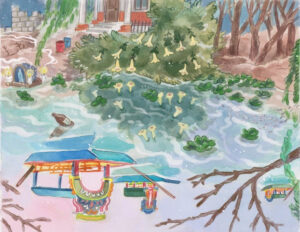
A trajinera waited nearby. Its bright colors looked obscene against the casona’s muted decay, yet perfectly normal against the water in Xochimilco. Its name, painted on the arch, was partially peeled. The letters were still legible enough to suggest a saint, a lover, or even a joke.
This was the final movement: the ferryman’s passage. The boat did not promise death. It promised distance, a southward drift, like a perfume settling into its base notes.
Notice texture and motion. Before language there is friction. Before meaning, contact.
As it moved south, the wood from the trajinera spoke with the canal through abrasion. The swollen oyamel (abies religiosa) gurgled with absorption, capillary action expanding fibers while loosening the nails binding the boat afloat. Hollow wood-on-water heartbeat reminded the planks of their once upright stance. Water entered grain; wood released tannins. Their conversation was intimate, fluid, and perhaps invasive. Along the hull’s underside, roots had been replaced by colonies of algae blooming into green mucus. They persuaded the trajinera’s paint to dissolve into mud.
The canal dragged along differently depending on what gathered beneath it. Sometimes smooth, accompanied by sway and trickle. Sometimes jagged and gritty, a burst below-surface colliding against suspended matter. Without the confines of a container, water spreads indiscriminately into the smallest of crevices or into the largest of spaces. Every clashing atom communicates in push, pull, twist, yield, and turn. Motion is tested in rhythm and choreography; texture shapes the tone of each conversation.
The casona’s phantasmagoric façade surrendered grain by grain to the lake wind. It usually conversed with itself since it could not maintain a conversation for long. Its smell did not help. The dampness of the chinampa’s surface tongued hairline fractures on foundation stones into crooked smiles yet it was unclear whether satisfaction was involved. The house groaned in recoil even though it existed here and there. Its windows participated in half-fogged enthusiasm. Dew renewed their Windex wash.
A tlacuache (didelphis marsupialis) slipped from the chinampa. Playing dead had not prepared it for this scare. The splash was inelegant and immediate. Water accepted its error and replied accordingly. Sediments erupted upward in cosmic brown spirals, anaerobic mud meeting oxygen and light for the first time in months. Charalitos swooped away in silver unison, a corps de ballet of collective redirection. Like unglazed ceramic, the water became granular. Suspended particles collided in the churn asking the current for help. It did what it knew: embrace.
Mexican violetears (colibri thalassinus) sometimes descended toward the canal. Their wings beat too quickly for eyes, but not for ripples. They tap danced on surface tension creating continuity in concentric circles. Their beaks shifted texture entirely: a precise puncture reminded water of life since it had observed the process of pollination. Nearby, mosquito larvae recoiled and reeds readjusted from the vibrations. Nothing received movement passively.
Life, however, is always accompanied by its counterpart. The trajinera drifted onward.
A slick spread thinly across the surface from a mysterious leak no one acknowledged. Hydrocarbons flattened the water’s texture into an iridescent mirror reflecting Xochimilco into violet, pink, and electric blue hues. Water skaters avoided the altered tension above, although snail eggs clung in sticky clusters below. The catfish (which were not endemic) didn’t mind. Their whiskered bodies continued to thread in the muck… they had endured worst textures before.
Clink against clink, even waste sought contact. Glass bottles with rims coated in chamoy settled among older debris. Grease-coated corncob sticks and the shiny wrappers from dorilocos got stuck in between. Aluminum pressed against softened styrofoam forming accidental reefs of fungal bloom among other more gooey unrecognizable substances. Trash danced tektonik in slow collisions and chemical exchanges. Plastic straws jerked like synthetic limbs. Cans and wrappers moved like a submerged moshpit, waiting to be slammed into each other with each passing boat.
At the water’s edge, detergent slipped from hands attempting to keep things clean at the casona’s edge. Soap ribbons adorned the canal’s corners where circulation slowed. Delicate strands imitated the soft texture of jabón zote while carrying rot beneath. Bacteria had accumulated in clumps, releasing methane in intermittent surface bursts. The canal exhaled decomposition onto its surface.
Mariachi music distorted through the water. Their trumpets and guitars muffled by distance, alcohol, and layers of grit—voces ahogadas. Narco-ballads softened into submerged pulses that brushed against the chinampa’s side before following the current. Lyrics disappeared first, but rhythm remained; deep thumps expanded outwards into the watery unknown. The canal had learnt to understand vibration better than language anyways. It had practice from the hummingbirds and the occasional earthquake. Sound entered the water as pressure, but it dissipated in other water bodies elsewhere. Sometimes it made them twerk.
For the canal, expansion involved unnecessary violence. Mud swallowing pollutants. Reeds filtering runoff. Microbes consuming what they could. Everything else offered the cynical resistance of late-stage-capitalism. Contamination planned a choreography for survival that abandoned natural cycles.
Beneath every texture, motion continued speaking its old argument: the world lives through contact. In push, pull, twist, yield, return.
A cempasúchil petal landed on the canal surface and spun slowly before being dragged by the current.
Notice those who watch. Their gaze upon you.
West from the casona, the ripples of the trajinera lapped at the edges of the Island of Dolls. It, in fact, was another chinampa; it had once held a milpa. Children and gartersnakes (thamnophis melanogaster) had crossed its corridors, hunting for a bird with a slingshot or for a teporingo (romerolagus diazi) distracted enough while chewing on an ear of corn. Beneath the shade of one of the ahuejotes (salix bonplandiana), sacred stones had been planted so that the winds would know to protect the harvest. These were, therefore, consecrated lands, yet long ago this chinampa had ceased to sustain cultivation.
Instead, it was now a cabinet of curiosities, a collection of plastic, porcelain, old rags, and lazy eyes—all fixed in an unblinking stare. A permanent audience for what unfolded in Xochimilco.
Strangled by rusted wires in a whimsical outpouring of artistic fervor, the doll’s bodies spoke of the childhood of religions—the innocent and perhaps unsettling beginnings of faith and ritual. Perhaps they dangled as tribute to forgotten deities or to a girl said to have lost her life in such place. Their pupils had become suspended between the terror that paralyzes desire and the desire that drives fear into flight. Lady Gaga had attempted to exorcize them through tarantella, but she had been unable to endure the mosquitoes that, with their aerodynamic cathedral-like anatomy, tracked the carbon monoxide and heat of her skin… perhaps she simply got lost in spectacle. The island had no interest in celebrities. It reduced them to another body among many.
Usually the dragonflies kept the mosquitos at bay. Their compound eyes fractured the world into thousands of points of motion. To them, the Island of Dolls was almost dead space. The dolls scarcely registered. Only a dress stirred loose by the wind, an insect crossing a rosy cheek, or a mosquito swollen with borrowed blood disturbed the stillness enough to become visible. To the dragonflies, the dolls were interruptions.
Among those interruptions was Citlalinicue, with her rainbow hair melted multicolor. She remembered some curious smoker who brought the spark of their cigar too close and a child mesmerized by the light of fireworks in the evening skies. Organic matter had accumulated within the joints of her movable extremities together with pollen carried there unintentionally by the hummingbirds. They saw in her ultraviolet signals: a false blossom offering of sweetness. They hovered before her painted lips and found no nectar, only the old smell of rainwater and human longing.
Tlazohteotl stood with torso and head, arms, legs, and belly all frayed. A crow returned to her shoulder each dusk, not out of reverence but because height offered perspective. Their eyes stitched together fragments the dolls themselves could not. It could track the silver convulsions of the charales, tourists dropping tortillas, and the swelling of a storm over the volcanoes. From above, decay and nourishment were interchangeable, but the crow knew better. They understood what Tlazohteotl had preached: rot was another appetite waiting to be fulfilled.
There, Xochiquetzal’s exuberant body conjured a telenovela heroine in acrylonitrile butadiene styrene plastic. Her beauty deceived the thrushes (ridgwayia pinicola) whose eyes, trained by hunger among berries and flowers, mistook her for ripe fruit. They pecked at divinity and found plastic.
The spiders didn’t mistake the dolls for bodies, but understood them as architecture. In Coyolxauhqui’s false eyelashes, and among the lace and ruffles of her strappy dress, spiders had spun their webs, continuing their dream of an interconnected world in spirals fastened to the branches of the trees, which the wind tightened and slackened as though it breathed with them. Their perception was shaped by silk tremors that became information: moth, leaf, warning, meal.
The gartersnake, in their hunt, split air into flavors. With their pit organs, they read the humidity and heat of the nearby teporingo. Sight usually confirmed what scent had already detected. Always vigilant, the teporingo discerned escape first, then food. They trusted no color or shadow, not even stillness. The dolls remained outside its inheritance of fear. They chose a broken porcelain face to linger for a single mouthful of grass. They were long enough for the snake to raise their head toward their faces before striking at the life beneath them.
The dolls watched everything without seeing.
That was their power. Their eyes had been manufactured for recognition, for children to find themselves reflected in miniature devotion. But here, beneath the western sky where the Fifth Sun disappeared each evening before beginning its hidden journey through the underworld, their gaze had become something older than expression. They no longer resembled toys. They had become ixiptla—substituted bodies, vessels through which presence lingered after identity dissolved. Effigies for ceremonies long forgotten and goddesses difficult to pronounce. They were witnesses of nature’s transmutations.
Across the canal, the séance continued. The casona exhaled dampness. The plants saw through their leaves. The spirits perfumed the atmosphere.
Then, for one suspended moment, every gaze crossed without meeting. Mosquito to skin, dragonfly to movement, hummingbird to color, crow to fate, spider to vibration, snake to rabbit… doll to nothing. And in the failure to see one another clearly, the ritual found its truth.
Their motionless lips spoke silently: “To perceive the movements of the gods, you must play as a child plays with a toy. The sensation is concentrated in every millimeter of wood, plastic, or paper from which the toy is crafted. The key is to activate space. Transform a small plot of land into a vast galaxy, a window’s edge into a long, ancient pathway linking the mountains to the lake. Then do the same with time. Imagine your clock as a map, assigning a unique territory to every day, hour, minute, and microsecond…until time, undone, whispers to your ear with a tongue of shimmering feathers drifting across the sky like a riddle posed to an oracle. Every being is woven into the same enchanted play. Have you learned your role? Be sown, and awaken.”
Notice the temperature.
It shapes the chinampa, like hands shaping clay, like breaths shaping fog, like gods shaping the world. Five times it has been warmed. Five times it has been cooled. Five times it began again in this water.
Xochimilco remembers each sun as a different way of holding heat. As earth, swallowing daylight into itself. Storing it in roots among worms and fungi. As water, welcoming it. Diluted. An offer for algae and fish. As stone, concealed beneath polished skin, returned only after darkness settled over the canal. As wood, remembering the summer growth. As body, lingering beneath ribs, tucked between organs, pooled in hollows at joints and beneath the tongue. As ritual… the candles did not illuminate the séance as much as they protected those around from the vast coolness gathering beyond.
Every dawn is a careful stirring of ancient embers. Listen with your skin. You might feel other temperatures trailing from the east.
At first, the world was scorched by jaguars sorcerers conjuring fire. Mountains rose and cracked. Life calcined into stone.
Wind entered, making water shiver. It whispered through the tule, through the grates of the casona’s old doors, through the hair of the drowned. The wind cools the fever left before.
Lightning interrupted in serpents cracked like whips. Rain came with drums and the sound of clay vessels shattering. Tlaloc’s fangs gleamed behind mourning veil. Every drop is a knife and a seed. The lake steamed.
Atl, tl, tl
Atl, tl, tl
Atl, tl, tl
The sound. Atl, tl, tl
Each drop, a waterfall.
Atl, tl, tl
Atl, tl, tl
Atl, tl, tl
There wasn’t light, nor movement. Atl, tl, tl
Only undifferentiated darkness. Still… but not quiet.
Atl Atl Atl Atl
tl tl tl tl
tl tl tl tl
tl tl tl tl
t l t l
Flood. Instead of falling, it rose. It covered fields. It entered burrow, and nest, and house. It will remember the shape of everything. Heat submerged and was drained away. The chinampa floats, but the channels overflow.
Light returns as warmth that knows its limits. We live in this sun. It entered through the cracks in the walls of the casona, yet it did not remain there: it passed through the table and the chairs (without even acknowledging the participants); the leaves of the plants could not hold it, and it sank into the ground beneath the tiles, tracing the paths carved by the roots. This is the sun of tending. Of keeping the death warm. This is the sun of the séance. The sun of now.
The heads of the gods lay there. Where the light had reached beneath the earth. From their feathered headdresses and thorny crowns, sprouted pumpkins, beans, flowers, and skulls. Like dogs standing at the thresholds of houses, they inhabited this liminal space. They heard the dreams of the ancestors carried by currents of icy water that pierced the lake like obsidian arrows. Their faces were formed from the debris that the waters lovingly embraced, giving order and a name to the reckless chance that had swept them there. They did not devour children, nor did they announce the end of times; they simply drifted like corpses carried by the current, ripening along their journey toward life.
Bubbles rose within and from below the chinampa, catching the fracturing light. They carried messages, eager to be heard—harmless gossip uttered in spherical words. The voices that had spoken them were trapped within the water’s simmering depths; they surged noisily to the surface before disappearing in faint pops.
“I heard a rumor…” “…that they came from far away.”
“…that some had never left, their roots here next to the chinampa.”
“… that some arrived after walking for miles and miles.”
“… that some drifted with the current, flew in, or hatched beneath the reeds.”
“… that some went barefoot until they ended up wearing shoes that covered them up to their ears.”
“… that others shed skins, unfurled feathers, and carried their homes with them.”
“Only their faces remained uncovered, so that their loved ones could bid them farewell.”
“… that some smiled.”
“… that their shadows bent as they disappeared into the afternoon.”
“Did they disappear, or were they there?”
“… that their feet, paws, roots, and fins inscribed upon the earth and water the maps of the worlds they dreamed of.”
“… that whenever they grew weary of moving, they rested in the middle of the desert, beneath the water’s surface, or among the reeds, gazing at the moon, the wind, or the rain, and then simply kept on going.”
“… that they were significant to others.”
“Were they, or were they there?”
“… that they began to deserve only when the earth was devouring their stomachs, while others had always belonged, long before deserving became a condition for remaining.”
“… that their voices became as shrill as the birdsong at daybreak, as deep as the mud, as quiet as submerged roots.”
“… that they wandered intoxicated by nectar, rain, memory or silt.”
“… that they departed dancing.”
“Did they leave, or were they there?”
“They were there, they were there, they were.”
“… that he fell at sunset. Drunk with a mezcal laughter. He tried to step from one trajinera to another, disappearing into the canal.”
The bubbles welled up from the most recent body that had become entangled below the chinampa. A saturation of corpses had prompted the casona to manifest here, again and again; it was easier to contact the spirits this way. Growing with a slowness that felt almost like a caress, periphyton spread across lifeless skin. The pallor of decomposition became a meadow of tuberoses beneath the light’s radiance.
At first, the body was warmer than the water. It fought the cold, skin goosefleshed, muscles cramped, lungs burned, water entered, heat left. The cadaver reached the same temperature as the canal. It became water with shape.
Bacteria released gases that swelled the body as though enacting the first stage of the alchemical journey. Heat returned with them… in fermentation the body bloated like a gourd filled with another’s breath. The dead grow warm yet again. The heat of decay fed the cycle, the algae, the insect, the fish, the bird, the mammal, the earth, the next sun.
Beneath clothes that floated like membranes, an axolotl (ambystoma mexicanum) nibbled at flesh. Having fed, their brown skin, mottled with black, took on a silvery hue tinged with pink. They carried Xolotl’s refusal to remain broken: as the dead surrendered flesh, the axolotl restored their own, growing limb by limb anew until the boundary between the dead and the living seemed little more than twisted membrane. Ritual reciprocity: nextlahualli. Some skin withered like the morning star, while other bloomed like the evening star. With slow sweeps of their tail, they gathered the lake’s offerings, transforming death into another beginning, so that every new being entered the world accompanied by their double. Through gills scorched by pollution, the axolotls received the departing spirits, holding them below until they rose again above the water as fragrance.
In the casona, wax slumped into pale lakes around the candle’s wicks. Smoke climbed toward the bowed glass roof, where it disappeared into condensation already waiting for it. The obsidian bowl reflected only the slow exchange between light and water, heat and cold.
The cempasúchil surrendered its last petal.
The beaucarnea remained still, though another ring had quietly begun beneath its bark.
The monstera unfurled the edge of a new leaf.
The orchids released a sweetness so faint it could only be perceived through imagination.
Outside, the canal accepted another offering: pollen, cigarette ash, tears, gasoline, fish scales, feathers, blood so diluted it no longer answered to that name. Everything arrived accompanied by something else.
The séance would continue. It had always been happening.
Later, much later, someone would open a door, wrinkle their nose, and say the place still smelled strange.
Smell arrives before story. It lingers after it, too.
About the authors
Roberto Jones Romo is a Mexico City-born writer and researcher whose work explores the intersections of contemporary art, esotericism, and the critical posthumanities. Currently pursuing a dual PhD at the National Autonomous University of Mexico (UNAM) and the University of Groningen, his research examines how aesthetic, symbolic, and spiritual practices challenge conventional understandings of the human and their relationship to the world. His writing moves between academic inquiry and literary experimentation, exploring the entanglements of memory, mythology, materiality, and the more-than-human world.
Mircea Gerardo Lavaniegos Solares is a Mexican literary scholar and researcher specializing in Western esotericism, comparative literature, and the intersections of art, religion, and spirituality. He is currently pursuing a PhD in Literature at the National Autonomous University of Mexico (UNAM), where his research explores the influence of esoteric traditions on modern literature, artistic expression, and cultural thought. His interdisciplinary approach examines how myth, symbolism, and the imagination shape literary and artistic representations of the sacred, revealing the enduring presence of esoteric traditions in modern cultural expression.
Credits
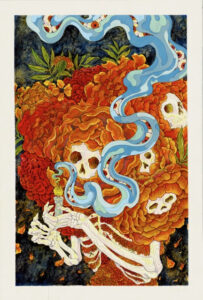
This essay was first published in November 2026. © Roberto Jones Romo and Mircea Lavaniegos Solares 2026. Image credits: “Xochimilco,” watercolor by Sandra Lavaniegos García (@melocotonki), 2026. “Nostalgia,” acrylic and watercolor stylograph by Walther Garcia Hernandez (@molka_oaxaca), 2024. Images used with permission of the artists.
The views and opinions expressed in this publication are those of the original author(s) and do not necessarily represent or reflect the views and opinions of Counterpoint: Navigating Knowledge, its co-directors, its board members, or its staff members.
Citation
If you are referring to this document, we recommend the following citation:
Jones Romo, Roberto, and Mircea Lavaniegos Solares. 2026. “Xochimilco.” Counterpoint: Navigating Knowledge, 2 November. https://counterpointknowledge.org/xochimilco/.
Permission to share
This work is protected under a CC-BY-NC creative commons license. Users may download, share, and build upon this work for non-commercial purposes, provided the original author and place of publication are always appropriately cited.

1 Comment
Four Directions, Many Voices: The Enchanted Ecologies of Xochimilco - Counterpoint: Navigating Knowledge · November 2, 2026 at 8:21 PM
[…] “Xochimilco” is an experimental work of speculative eco-magic surrealism that explores multispecies perception, ritual, mythology, and the entangled ecologies of the Xochimilco ecosystem. Moving among plants, animals, water, buildings, and discarded objects, its narrative asks what becomes perceptible when human experience ceases to organize the world. […]