Life Cairns: Embracing Grief, Building Hope
We are living in a time of profound transformation. The powers east and west of the Atlantic—which, as Edouard Glissant pointed out, is the site of the largest unmarked grave in history—are losing their influence. Past privileges are being challenged, but the system won’t break down easily. The toxic regimes of colonialism, capitalism, and patriarchy are fighting desperately to prolong their power. Consequently, we witness the rise of fascism and state terror in the United States, as well as the militarization of European societies, which would have been unimaginable a few years ago.
The multiple crises affecting human societies today are so overwhelming that they overshadow the accelerating ecological tragedies on a planetary scale. Perhaps Báyò Akómoláfé is right when he says that our solutions may be part of the problem. This means that “we can’t get there from here.” Confronted with despair and grief, we must sit down and take the time to figure out how to build relationships with the living world rooted in love, trust, and respect.
This is where the Life Cairns come into play.
British author, storyteller, and ecologist Andreas Kornevall was one of the first to bring forth the idea of a Life Cairn. Like many of us, he has experienced environmental grief. He writes:
As the world’s rainforests and species diminish like the snows in spring, many I meet are finding themselves in an existential depression. The nihilism found in our consumption, and our appetite for violence, are pathologies which have arisen to fill a void left by an absence. Our emotional response to what is happening with the world and the larger collapse of our climate has not yet begun; the river of tears is dammed for now. I fear those tears for the following generations.
Kornevall cannot fathom how politicians, spiritual leaders, and secular leaders could remain silent when
a species was lost after millions of years of evolutionary life. No wreath, no flowers, not even a song was offered as remembrance. There was only science and silence when the Yangtze River Dolphin was lost: her obituary was the static sound of radio waves and a tick on an IUCN Red List.
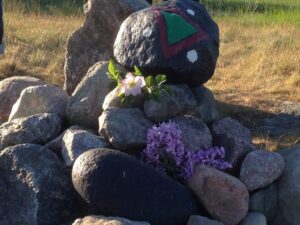
In response, Andreas Kornevall and Anglican priest, BBC presenter, and author Peter Owen Jones laid the foundation for the first “Life Cairn” on Mount Caburn in East Sussex, UK, on 22 May 2011 (you can watch a video of the event here). The term refers to the Old Irish word for a pile of stones that was built for a purpose, such as a marker or burial mound. A “Life Cairn” combines the ideas of burial, remembrance, and new life.
Life Cairns are a way to remember, honor, and mourn lost species of animals, plants, and other life forms that have become extinct due to human interference. People bring a stone representing a lost species to the Cairn. This can be done individually, but the Cairns are also communal gathering places where people can share their emotions and raise awareness about the importance of biodiversity. They are places of ceremony and interspecies becoming.
Two special dates are Global Biodiversity Day on May 22 and Lost Species Day on November 30. Andreas Kornevall compiled a PDF of lost species names that can be used in ceremonies. Of course, this list cannot include all 55,000 species that go extinct every year. What is more, we only know about 20 percent of the world’s species—80 percent are still unknown to science! American ecologists Manfred Boehm and Quentin Cronk coined the term “dark extinction” to describe this phenomenon. A separate plaque and ceremony at the Cairn would be needed to honor the species that have gone extinct without ever receiving official human attention.
On 26 July 2012, a Life Cairn was dedicated to the ‘endling’ (i.e., the last known individual of a species) Lonesome George at the Galapagos National Park. In Europe, the Life Cairn concept gained popularity in Scandinavia and particularly in Sweden. The Lodyn network of ecopsychology, environmental awareness, and activism built a Livsröse, the Swedish word for Life Cairn, in the center of Stockholm. In 2012 it was established in the national city park of Stockholm and in 2014 it moved to Gärdet, where it has been well visited with many ceremonies over the years.
Zara Waldebäck from the Scandinavian Center for Shamanic Studies recently played an instrumental role in establishing Livsröse Syd. In collaboration with the Skånska Landskaps Foundation, they found a place for the Cairn in a wild nature reserve in southern Sweden.
It is fascinating to learn about the different experiences and insights that Andreas Kornevall, Henrik Hallgren from Lodyn, and Zara Waldebäck share in a recent webinar. Their reflections on the question, “What can we do to keep our hearts open in the face of great ecological grief?,” reveal the importance of ceremony and communal sharing. In a ceremonial setting, community encompasses both human and nonhuman people, including those driven to extinction by human arrogance.
Kornevall, Hallgren, and Waldebäck also point out how important it is to involve people from all ages and all walks of life. Only if the local community joins the activities of artists, scientists, spiritual practitioners, and environmentalists, will the Life Cairn become an agent of communal remembrance and healing.
Building and tending a Life Cairn resists the urge to come up with quick solutions. It takes time. It takes patience. It requires continued awareness and devotion. Perhaps this is where its transformational power stems from. Allowing the river of tears to flow freely can create new spaces for kinship, peace, and loving trust across species and spiritual ecologies.
I hope this important initiative inspires people around the world to build and maintain their own Life Cairns. Here is some practical information if you want to learn more and get involved:
Watch the Life Cairn webinar: https://www.livsrosesyd.se/buildcairns
There will be another free online meeting in Spring 2026 offering advice on how to get started building and tending Life Cairns.
To take part, make sure to sign up to the list on this page: https://www.livsrosesyd.se/buildcairns
#
Kocku von Stuckrad is one of the co-founders and co-directors of Counterpoint: Navigating Knowledge. As a Professor of Religious Studies at the University of Groningen (Netherlands), he works on the history of religion, science, and philosophy in Europe and North America. His most recent books are Nach der Ausbeutung: Wie unser Verhältnis zur Erde gelingen kann (Europa Verlag; English edition will be published with Equinox Press in August 2026 as After Exploitation: How We Can Build Flourishing Relationships with the Earth) and A Cultural History of the Soul: Europe and North America from 1870 to the Present (Columbia University Press).
Counterpoint blogs may be reprinted with the following acknowledgement: “This article was published by Counterpoint Navigating Knowledge on 1 February 2026.” The views and opinions expressed on this website, in its publications, and in comments made in response to the site and publications are those of the author(s) and do not necessarily reflect the views and opinions of Counterpoint: Navigating Knowledge, its founders, its staff, or any agent or institution affiliated with it, nor those of the institution(s) with which the author is affiliated. Counterpoint exists to promote vigorous debate within and across knowledge systems and therefore publishes a wide variety of views and opinions in the interests of open conversation and dialogue.
Photo credits: “Livsröset” © Lodyn, downloaded from https://www.lodyn.se/livsroset/.
0 Comments