Past President Future Tense
By Evan Berry
Over the past decade, but especially since the beginning of Trump’s second term, the US federal government has steadily intensified its assault on institutions of higher education, on climate science, on student activist organizations, on student loan forgiveness programs, and on programs of study that focus on social and racial inequalities. Colleges and universities have never been apolitical spaces, but in the United States the ‘culture wars’ are no longer just a feature of social life to be researched and analyzed, not an abstract disturbance beyond the cloisters of campus life.
Admittedly, these issues stem from U.S. political culture, but they are disrupting institutions and institutional networks that are thoroughly transnational. Institutions of higher education in the U.S. remain pivotal in the global economy of knowledge, and these institutions, especially those in the public sector, are struggling with issues core to their mission: academic freedom, public trust, meritocratic distribution of resources, and fair treatment of international students and workers. These challenges are hardly new, but they impact some knowledge domains more than others, many of which are woven into the nexus of religion, nature, and culture; for example, decolonial and anticolonial frameworks, critiques of religious nationalism and dominion theology, and analyses of ecological crises that draw on feminist, antiracist, or queer theory.
What does it mean to study religion and nature under such conditions? What should be the orientation of researchers living and working under such duress? How best to pursue scholarship regarding politically and theologically charged topics? What is the value and role of scholarly organizations in this moment of academic precarity? These are weighty questions that are being actively discussed in every corner of higher education, from the board room to the classroom. This is a mere blog post, not even properly a scholarly essay, but I want to offer a few thoughts about these anxious questions as means to situate the International Society for the Study of Religion, Nature, and Culture within broader currents of transdisciplinary knowledge exchange and to imagine its future trajectories.
Let me begin with a premise: knowledge about polycrisis cannot be separated from advocacy and activism. Scholarly engagement with planetary sustainability, political and economic inequality, and cultural embedded systems of power is fundamentally oriented towards affecting positive change. And this is especially true where religion, spirituality, ritual, and myth are used as central conceptual terms for understanding the societal structures underpinning planetary scale ecological disruption. As Anna Gade argues it in her excellent book Muslim Environmentalisms, the very idea of “environmental issues” presupposes a host of ethical, ecological, and cultural norms operating in the background of environmental humanities and social science research. Academic research and university teaching are always already forms of advocacy, albeit traditionalist and incrementalist, that aim to foment better futures and avoid worser ones. Candor about the normative entanglements of knowledge creation is not uniquely related to the climate crisis or to the study of religion; this is a basic, widely accepted orientation to the sociology of knowledge that has been in wide circulation since the inception of feminist science studies and the work of scholars like Sandra Harding and Donna Haraway in the 1980s. If we begin with the premise that knowledge is never neutral, what does that mean about the ISSRNC?
Two observations follow from this premise. First, because scholarship related to the religious and cultural aspects of planetary ecological crisis generates knowledge that is by definition political, organizations like the ISSRNC have an important role to play in sharing and circulating that knowledge. If the field(s) that the ISSRNC serves are, at least to a significant extent, involved with understanding polycrisis, then its transdisciplinary, multimethodological orientation should be valued not just as a space for academic excellence, but also for making and sharing knowledge about our ecological afflictions and their remedies.
Second, international civil society organizations are as important now as they have ever been. The ISSRNC has since its inception prioritized building and maintaining transnational scholarly networks. The 2026 gathering in Venice will be the Society’s 13th conference, and its sixth conference outside the United States. Although colleges and universities in the United States remain among the best in the world, resilient organizations that link researchers working across many geographic and political contexts provide a critical buffer against the slow but steady degradations of academic freedom happening there. Organizations like the ISSRNC are essential for the distributed, transversal, global forms of knowledge that are required by polycrisis; as an international organization, the ISSRNC provides modest, but invaluable infrastructure for scholarly collaboration and exchange across borders and educational systems.
These are essential aspects of the ISSRNC’s work and these will be part of what organizational success will look like going forward. Fields of scholarly research related to religion, nature, and culture are necessarily transdisciplinary, transnational, and transformative, and the organization will be able to meet this difficult moment by building on its strengths in these areas.
This blog post is the second in a series about the history of the ISSRNC. In preparation for the ISSRNC’s 20th-anniversary conference in Venice in October 2026, all of the association’s former presidents will share their experiences and insights
#
Evan Berry is Associate Professor of Environmental Humanities in the School of History, Philosophy, and Religious Studies at Arizona State University. Berry is the author of Devoted to Nature: The Religious Roots of American Environmentalism (University of California Press, 2015) and editor of Climate Politics and the Power of Religion (Indiana University Press, 2022). He served as the President of the International Society for the Study of Religion, Nature, and Culture from 2020 to 2023.
Counterpoint blogs may be reprinted with the following acknowledgement: “This article was published by Counterpoint Navigating Knowledge on 24 April 2026” The views and opinions expressed on this website, in its publications, and in comments made in response to the site and publications are those of the author(s) and do not necessarily reflect the views and opinions of Counterpoint: Navigating Knowledge, its founders, its staff, or any agent or institution affiliated with it, nor those of the institution(s) with which the author is affiliated. Counterpoint exists to promote vigorous debate within and across knowledge systems and therefore publishes a wide variety of views and opinions in the interests of open conversation and dialogue.
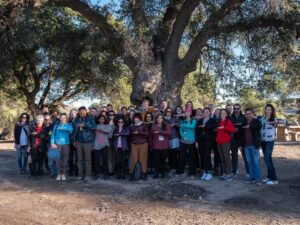
Image credits: Photo from the Oak Flat field trip at the ISSRNC conference in 2023. © Evan Berry.



0 Comments