Religion, Ritual, and Ecology
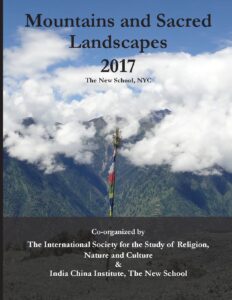
I served as ISSRNC’s President from 2015-2018 and was fortunate to take the position after Bron Taylor’s, Kocku von Stuckrad’s, and Laura Hobgood’s leadership had already turned the society into a vibrant community of scholars. During and before my presidency I worked on many of our conferences and co-organized the 2017 ISSRNC Mountains and Sacred Landscapes Conference at The New School in New York City, April 2017, with Chris Crews and Ashok Gurung of the New School’s India China Institute. During my tenure on ISSRNC’s Board, I was the co-organizer, with Pepperdine University’s Chris Doran, of ISSRNC’s 2012 conference “Nature and the Popular Imagination” at Pepperdine’s campus in Malibu, California. One of the most rewarding aspects of my involvement with ISSRNC has been supporting our collegial conference communities as welcoming venues for international and early-career scholars.
Our conferences and my ISSRNC colleagues have also fundamentally shaped my own scholarly career. Although I spent the early years of my career focusing on “nature religions,” such as contemporary Paganism, relationships between humans and the more-than human natural world were not my central concern. As I spent more time in conversation with colleagues at our conferences, this changed. My scholarly work since I joined the ISSRNC Board in 2010 has increasingly focused on the intersection of religion, nature, and culture, especially where ritual practices are involved.
ISSRNC has always been interdisciplinary, which is one of its great strengths. Engaging with social scientists, theologians, environmental studies scholars, and activist-scholars has pushed my scholarship in new directions. Much early research in religion and ecology was more philosophical and theological, paying little attention to the actual bodily practices through which humans relate to the more-than-human world (with a few exceptions of course, such as the work of Bron Taylor, David Haberman, and Rebecca Gould, among others). Our field has changed much since then and attention to lived religion and field work methods are more common now, with empirical case studies of specific communities at specific times and places regularly appearing in our conference programs.
My involvement with the field of ritual studies developed at the same time that I became involved with ISSRNC and I began to wonder how to bring these interests together. During my presidency, we organized “working groups” to create conversations that would be active between conferences, and one of these was focused on ritual. The groups did not last long, but they deepened my engagement with ritual studies, which culminated in an ethnography of radical environmental and animal rights activism in 2017, in which I focused on how ritualized practices both express and constitute relationships with more-than-human beings and landscapes. Since then, I have continued to draw on ritual studies to explore relationships between humans and the more-than-human at climate protests, disaster memorials, nature sanctuaries, and most recently, in the past six years, in restoration work after catastrophic wildfires in California, where I live.
My recent research on ritualized post-disaster restoration work has been informed by experiences at ISSRNC conferences, especially the perspectives of Indigenous scholars and activists, most powerfully by Winona LaDuke’s (Mississippi Band Anishinaabeg) talk at the 2016 ISSRNC conference in Florida. In addition, thanks to ISSRNC, I first came across the work of environmental philosopher Kyle Powys Whyte (Citizen Potawatomi Nation) on settler colonialism and environmental issues. Although I taught a class on American Indian worldviews for a few years, I was not trained in Native American Studies and as a European American settler scholar avoided direct research on Native American topics. My only connection to Native American studies was to describe and analyze cultural appropriation and decolonization work in the communities I was researching (Contemporary Pagans and radical environmentalists).
Five years ago, I began volunteering at a Tribally run plant restoration site in Chico, California where my university is based, never intending to write about the site. But you can’t take the scholar out of the volunteer, and I found myself fascinated with Indigenous Traditional Ecological Knowledge (ITEK) practitioners, especially cultural fire practitioners, and their non-Native allies. I continued to be a participant-observer at events that foregrounded Tribal knowledge. My approach has not been to focus on Tribal practitioners, since plenty of Indigenous scholars have written about cultural fire. Instead, I am interested in exploring collaborations and tensions between Indigenous and non-Indigenous restoration practices, such as prescribed fire, beaver mimicry in process-based restoration, and re-planting landscapes after wildfire. At restoration sites, non-Indigenous participants engage in reparations and decolonization work, alongside Indigenous participants who are reclaiming and sharing the millennia-old teachings of their cultures.
Catastrophic fires in California in the last decade or so have revealed cultural, ecological, and ritual histories related to colonization and ongoing conflicts between Indigenous communities and white settler communities in California. But wildfire disasters, such as the 2018 Camp Fire ten miles from my university’s campus, catastrophic as they were, also created new and rekindled older relationships between humans and the devastated land, facilitating ritualized restoration practices involving fungi, native plants, earthworks, and prescribed fire. Ironically, government agencies and vulnerable communities are currently turning to those very Tribes whose ceremonies they historically suppressed, for help bringing ecological balance back to California landscapes. In an area of California that was devastated by the combined genocide and ecocide of colonial settlers, especially during the Gold Rush of the mid-nineteenth century, catastrophic wildfires have led to the need for more (intentionally set) fire on the land and the revival of Indigenous relationships with fire that were suppressed two hundred years ago.
Decolonization involves the active reclaiming of older practices of relating to the land among Native American Tribes in this region. These ways treat fire and plants as persons to whom humans have responsibilities that are ritually expressed and reclaimed during restoration work involving fire. Relationships and practices involving restoration work by non-Indigenous groups can either further power relations of colonization by appropriating Indigenous knowledges, or function as rituals of reparation for a colonial past and its cultural and ecological devastation. These are the issues I have now turned to writing about and I am grateful to the many ways that my involvement with ISSRNC continues to shape my approach to ritual, religion, culture, and ecology. Given that the climate crisis and its consequences for all living beings are the existential challenge of our time, turning to local restoration practices that aim to restore balance to the ecological communities in which we live and work seems ever more urgent.
This blog post is the third in a series about the history of the ISSRNC. In preparation for the ISSRNC’s 20th-anniversary conference in Venice in October 2026, all of the association’s former presidents will share their experiences and insights.
#
Dr. Sarah M. Pike is Professor Emerita of Comparative Religion at California State University, Chico. She has written numerous books, articles, and book chapters on contemporary Paganism, ritual, the New Age movement, the ancestral skills movement, Burning Man, spiritual dance, California wildfires, environmental activism, climate strikes, and youth culture. Her most recent book is For the Wild: Ritual and Commitment in Radical Eco-Activism. Her current research focuses on ritual, spirituality, and ecology in several different contexts, including a project on ritualized relationships with landscapes after wildfires.
Counterpoint blogs may be reprinted with the following acknowledgement: “This article was published by Counterpoint Navigating Knowledge on 12 May 2026” The views and opinions expressed on this website, in its publications, and in comments made in response to the site and publications are those of the author(s) and do not necessarily reflect the views and opinions of Counterpoint: Navigating Knowledge, its founders, its staff, or any agent or institution affiliated with it, nor those of the institution(s) with which the author is affiliated. Counterpoint exists to promote vigorous debate within and across knowledge systems and therefore publishes a wide variety of views and opinions in the interests of open conversation and dialogue.
Image credits: Official announcement of the 2017 ISSRNC Mountains and Sacred Landscapes Conference at The New School in New York City,.



2 Comments
Religion, Animals, and Academia - Counterpoint: Navigating Knowledge · June 10, 2026 at 9:14 AM
[…] may be reprinted with the following acknowledgement: “This article was published by Counterpoint Navigating Knowledge on 10 June 2026” The views and opinions expressed on this website, in its publications, and in […]
Religion, Ritual, and Ecology – International Society for the Study of Religion, Nature, and Culture (ISSRNC) · July 21, 2026 at 4:34 PM
[…] may be reprinted with the following acknowledgement: “This article was published by Counterpoint Navigating Knowledge on 12 May 2026” The views and opinions expressed on this website, in its publications, and in […]