Queer Muslims: Spiritual Resistance to Current of Islamic Conservatism in Indonesia
In recent years, tensions between queer identity and religion in Indonesia have intensified amid the rise of a type of conservatism that rejects gender diversity. Queer groups are often seen as non-religious and excluded from legitimate spiritual spaces. As a result, queer communities are frequently marginalized from religious life, even though they possess deep and authentic spiritual experiences. In fact, history and local culture show that the relationship between queerness and spirituality is not foreign to Indonesia—traditions such as the Bugis Bissu have long recognized figures who transcend gender binaries and embody profound spirituality.
According to Karlina Supelli (p. 201), religious conservatism emerges when the spiritual function shifts into merely a legal system function—laden with debates over what is “right” and “wrong.” Religion then loses its reflective power and turns into an instrument of control. This condition illustrates what Mark Juergensmeyer (p. 10) describes as the reduction of religion into a cosmic narrative that separates “us” and “them,” the sacred and the profane. When this narrative is applied in social life, it gives rise to moral violence against those who are different. Jonathan Sacks (p. 9-10) even refers to this phenomenon as altruistic evil—cruelty committed in the name of truth and holiness.
Long before the advent of “queerness” in western discourse, the existence of queerness in Indonesia had already appeared, with its presence being closely connected to aspects of spirituality. Refan Aditya’s article titled “Menemukan Allah: Tantangan Menjadi Saint Queer di Tengah Arus Konservatisme Agama” (Finding Allah: The Challenge of Being a Queer Saint amid the Current of Religious Conservatism) highlights the stories of two Bissu—Puang Aji Didi and Bissu Yuni—who negotiate their identities as both queer and Muslim. Amid social and religious pressures, both discovered that being queer does not mean losing God, but rather provides a path to finding God. Puang Aji Didi realized that his existence as a queer person is a divine destiny that must be accepted and lived with spiritual responsibility, while Bissu Yuni found peace in believing that her destiny as a Bissu is a form of devotion to Allah and the Bugis community. Their stories affirm that queerness does not exist apart from a spirituality, but is instead positioned as another way to approach God—through acceptance, struggle, and self-awareness.
Judith Butler’s theory of performativity in Gender Trouble (1990) challenges the traditional view that sees gender as something essential and inherent to individuals from birth. According to Butler, gender is not a fixed attribute or an essential identity, but rather something that is enacted or performed. Within this framework, gender identity is constructed through continuous actions and behaviors that create the illusion of stability or naturalness (p. 133). Thus, gender identity is never “given” from the beginning but is born out of social construction and repetition over time.
The rise of religious conservatism in Indonesia and its use of rigid interpretations of gender/sex serves as a clear example of how performativity is controlled by mainstream religious institutions. Within such discourse, queer bodies are often made out to be deviant. Labels such as “unnatural” or “ungodly” are used to maintain a patriarchal social structure. However, following Butler’s logic, “nature” itself is not something beyond performative construction. The notions of a “real man” or a “real woman” never truly exist as essential categories; instead, they are formed through the repetition of actions and rituals legitimized by some religious and scientific institutions.
Amar Alfikar, in his book “Queer Menafsir: Teologi Islam untuk Ragam Ketubuhan,” (Queer Interpretation: Islamic Theology for Diverse Embodiments) seeks to deconstruct mainstream interpretations of gender and sex and offers an alternative: a queer-inclusive Islamic theology. The book argues that all humans, regardless of gender identity or sexual orientation, have equal potential to know God. By incorporating Sexual Orientation, Gender Identity and Expression, and Sexual Characteristics (SOGIESC) into Islamic discourse, Amar opens space for more diversity among humans (p. 86). Queer theology, he argues, is not merely minority advocacy but a moral call for all Muslims. If Islam truly values justice and peace, theologies that exclude groups of people contradict its spirit. God’s creativity, Amar emphasizes, has no limits. Thus, true faith lies not in blind obedience but in empathy and compassion toward all creation.
He connects this idea to the Sufi principle of ihsan as explained by Haidar Bagir—ihsan being the highest stage of faith, marked by closeness to Allah that manifests in love, gentleness, and nobleness. In Sufism, love is the source of creation: Allah created humans out of His love. Thus, hatred toward others contradicts human nature as beings born from love. Ibn Arabi even teaches that love is God’s presence within humans; through love, one comes to know God more deeply. From this view, queer theology is not only a theology of liberation but also of love—reaffirming that compassion lies at the heart of faith. However, instead of embodying love, Islam is frequently expressed through anger, with some believers busy condemning and excluding others. Amar calls this takfirism—the tendency to label those who hold beliefs different from you as nonbelievers. Such takfirism distances people from Islam’s core message: the more one enforces boundaries around faith, the farther one strays from its spirit (p. 440).
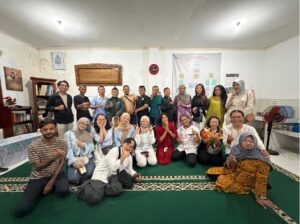
The presence of the Pesantren Waria Al-Fatah in Yogyakarta serves as a concrete example of the type of love articulated by Ibn Arabi. In this place, transgender women study Islam and worship. They do not reject religion; instead, they reinterpret religiosity in their own way. When they recite dhikr and study the Qur’an, it is not merely an act of worship, but also a form of reclaiming their right to their Islamic spirituality and identity.
From this perspective, queerness is not a threat to religiosity but a part of the spiritual diversity of humankind. Queer bodies remind us that God is present not only in uniformity but also in the diversity that challenges commonly accepted boundaries. Ultimately, the emergence of queer spirituality in Indonesia is not merely a form of resistance against extreme conservatism but an effort to reaffirm the deepest meaning of religiosity itself. In its complexity, the queer body becomes a symbol of courage—to live authentically within a society that often demands conformity.
#
Muhammad Harkim Novridho is a young researcher and cultural activist from Bengkulu, Indonesia, and a Master’s candidate at the Center for Religious and Cross-cultural Studies (CRCS), Universitas Gadjah Mada. He holds a Bachelor’s degree in Theology and Islamic Philosophy, which shaped his foundation in critical thought, philosophy of religion, Islamic intellectual traditions, pluralism, and the dynamics of religious authority in contemporary Indonesia. His research interests focus on the intersections of religion, culture, and power relations in Indonesian society, particularly within local contexts navigating national and global currents. He is interested in examining how traditions, identities, and religious practices are negotiated amid social transformation, and how minority communities articulate meaning, agency, and their own visions of sustainability. His approach combines theoretical reflection and critical engagement with public discourse to understand plural realities. Through his academic and intellectual work, Harkim seeks to foreground minority experiences as legitimate and vital sources of knowledge in global conversations on religion, culture, and shared futures.
Counterpoint blogs may be reprinted with the following acknowledgement: “This article was published by Counterpoint Navigating Knowledge on 5 March 2026.” The views and opinions expressed on this website, in its publications, and in comments made in response to the site and publications are those of the author(s) and do not necessarily reflect the views and opinions of Counterpoint: Navigating Knowledge, its founders, its staff, or any agent or institution affiliated with it, nor those of the institution(s) with which the author is affiliated. Counterpoint exists to promote vigorous debate within and across knowledge systems and therefore publishes a wide variety of views and opinions in the interests of open conversation and dialogue.
Photo credits: Personal Documentation, © Muhammad Harkim Novridhom 2026


0 Comments