Religion, Animals, and Academia
As a PhD student in 1994 I thought nobody else found questions of religion and nature both fascinating and incredibly important. Luckily, Belden Lane emerged as my dissertation adviser. He contributed an early voice to religion and nature in North America. Then I (not so randomly) ran into Bron Taylor, Mary Evelyn Tucker, John Grim, Jay McDaniel, Carol Adams, Paul Waldau, Sarah Pike, Roger Gottlieb, and so many more—colleagues central to my formation as a teacher-scholar in the area of religion, nature, and animals.
That entre by those groundbreaking leaders pulled me, luckily and thankfully, into what would become the ISSRNC. Working with Bron Taylor on the Encyclopedia of Religion and Nature as the Executive Editor for the Gender and Nature/Ecofeminism Task Force , it became evident that this field was my home. I jumped in happily! Not only were the publications groundbreaking (Encyclopedia and Journal), but what amazing conferences! As the treasurer during the Morelia (Mexico) and Amsterdam (The Netherlands) years, and then the president for the Pepperdine (CA, USA) and Rome (Italy) years, so many exciting, trailblazing, and important ideas came from these gatherings. The early years proved challenging and time consuming. For most of those I still held a junior position at my institution, so making sure to check off those boxes for tenure had to happen. The opportunities offered by the ISSRNC to me and to other junior scholars were so important.
But the reasons for involvement and leadership in the ISSRNC went beyond those academic landmarks. Simultaneously establishing an Environmental Studies program at a small liberal arts college in Texas (oh my!) while I held officer positions in ISSRNC gave me a grounding. Colleagues in the Society continued to support efforts for a faculty person in a place (Texas) and at an institution (small undergraduate) that helped make it all happen.
My story with the ISSRNC speaks to what I see as one of its many gifts to scholarship—the space it provided and continues to provide for emerging scholars to explore and share their ideas and voices. Many of the “new scholars” (as I became more senior) now serve as leaders in the Society—Whitney Bauman, Lucas Johnson, Evan Berry, Kristina Tiedje, and the list goes on and on.
In addition, those connections led, early on, to starting the Animals and Religion group at the American Academy of Religion. The Animals and Religion Unit remains vibrant over twenty years later and thrives under new, incredible leadership (colleagues such as Christopher Carter, Dave Aftandilian, Barbara Ambros, and Aaron Gross). While distinct from the goals of the ISSRNC, it forms one of many of the branches of intersecting conversations existing on international levels. During the climate and extinction crisis, such necessary conversations need to be, and are, nourished by the ISSRNC.
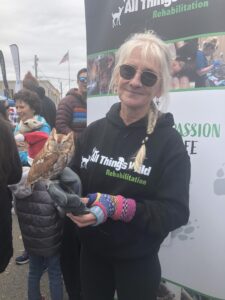
While my life choices meant time went elsewhere, life still kept me inside the ideas of ISSRNC. Hours of dog and puppy rescue and more recently hours of wildlife rehabilitation put me in the trenches. As a feminist-scholar-activist, time and efforts mean that rehabilitating an orphan fox squirrel takes priority over professional societies. This is particularly true when faced with the increasing number of natural (and unnatural) disasters. Most recently in Texas those disasters include horrible winter cold and storms. Trees destroyed by an ice storm send scores of orphaned squirrels into rehabilitation. And coastlines ravaged by hurricanes mean dogs from shelters must quickly be evacuated. When these events occur, and tragedy hits, everything else goes on the back burner. But being part of a professional society provided me the footing for the hands-on activisms of the important “now” in my life.
Twenty-five years and many relationships, collaborations, friendships, struggles later, I think this organization cemented so much of my own academic work and that of so many colleagues. It was an honor to be a leader in the early years and to stay connected for so long. The river of life sometimes takes us down tributaries that steer away from some streams that once drove us, but the foundations and ideas of the ISSRNC will and should continue to provide not only encouragement but power to those voices thinking “religion, nature, and culture” in the challenging years to come.
This blog post is the fourth in a series about the history of the ISSRNC. In preparation for the ISSRNC’s 20th-anniversary conference in Venice in October 2026, all of the association’s former presidents will share their experiences and insights.
#
Dr. Laura Hobgood holds the Paden Chair in Religion and Environmental Studies at Southwestern University. She is the author or editor of five books and has contributed numerous chapters to other volumes and journals. Hobgood’s primary interests involve the study of animals and religion, religion and the environment, and ecojustice. When not teaching and researching, she spends her time cycling, rehabilitating wildlife (especially squirrels), and fostering dogs. Dr. Hobgood served as treasurer and president of the ISSRNC.
Counterpoint blogs may be reprinted with the following acknowledgement: “This article was published by Counterpoint Navigating Knowledge on 10 June 2026” The views and opinions expressed on this website, in its publications, and in comments made in response to the site and publications are those of the author(s) and do not necessarily reflect the views and opinions of Counterpoint: Navigating Knowledge, its founders, its staff, or any agent or institution affiliated with it, nor those of the institution(s) with which the author is affiliated. Counterpoint exists to promote vigorous debate within and across knowledge systems and therefore publishes a wide variety of views and opinions in the interests of open conversation and dialogue.
Image credits: © Laura Hobgood.



1 Comment
Religion, Animals, and Academia – International Society for the Study of Religion, Nature, and Culture (ISSRNC) · July 21, 2026 at 4:40 PM
[…] article was published by Counterpoint Navigating Knowledge on 10 June […]