Companions and Partners in a More-than-human World:
A Counterpoint: Navigating Knowledge Research Colloquium
on 30 March 2026
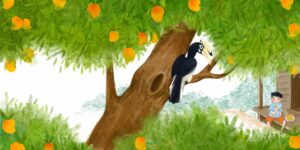
In the forested landscapes of Tripura, a small region in Northeast India, the hornbill occupies a significant position. Since 2020, the state government sponsors a two-day Hornbill festival (https://timesofindia.indiatimes.com/travel/destinations/tripura-to-host-hornbill-like-festival-from-february-8/articleshow/73868097.cms.) The festival, which has been adopted from the neighboring state of Nagaland, serves to boost tourism and raise awareness of the need to protect this endangered species. The northeastern region has the highest diversity having five hornbill species. Among them, Oriental Pied Hornbill has a wide range of distribution throughout northeast India, which is covered by dense forests. However, the decline in oriental pied hornbill population has been reported mainly due to felling of old and big trees and hunting, which decreases the availability of suitable nesting and fruit trees.
In Tripura, the hornbill plays an important role in the stories and worldviews of indigenous communities. Instead of being merely understood as a faunal species within conservation biology, the hornbill emerges as a more-than-human companion embedded in multispecies relationships that formed cosmological understandings, land-use practices, and moral obligations toward the forest among the Indigenous tribes of Tripura. This is reflected in everyday lived experiences with hornbills, where Indigenous communities such as the Molsom and Hrangkhawl observe restrictions against killing them.
In Nagaland, for the Sumi Nagas, the legend of the Great Hornbill has made it a symbol of inseparable love. The birds are considered monogamous, as they have only one partner in their entire lives, making them the perfect symbol of unending love and passion. They are also believed to be extremely caring towards their mates and children. There are many variations of a myth that traces the origin of this colorful bird to the unrequited love of a human orphan boy. He transforms from a human outsider into a mythical lucky charm in the form of a bird, who gives his beloved one of his colorful and blessed feathers every year.
The hornbill is thus an outstanding example of a non-human companion and part of the family for indigenous communities in Northeast India. Environmental anthropologist Ambika Aiyadurai has documented a similar close relationship between the Mishmi community and the tigers in Arunachal Pradesh. Mishmi people living on the Sino-India border claim tigers to be their brothers and take credit for tiger protection as they observe taboos against hunting tigers. Drawing on this notion of relatedness with tigers, residents of the Dibang Valley questioned government plans to declare the Dibang Wildlife Sanctuary into Dibang Tiger Reserve. In her book Tigers are our brothers (https://global.oup.com/academic/product/tigers-are-our-brothers-9780190129101?cc=my&lang=en&), Aiyadurai shows how indigenous lifeworld and practices contest with conservationist versions of state and global environmental policies.
A one-day workshop, featured by Counterpoint: Navigating Knowledge aspires to foreground indigenous and local cosmologies in Northeast India that conceptualize animals, plants, rivers, forests, and other landscapes entities as companions, siblings or kin. Such relational ontologies invite critical reflection on dominant conservation regimes, environmental governance frameworks, and scientific epistemologies that often separate nature from culture and humans from non-humans. Keeping these thematic areas, the workshop with several research panels will provide insights into the vibrant tapestry of plant and animal interrelationships in Northeast India.
Examples include the role of water in stories of indigenous communities in North-East-India. It builds on that scholarship through a narrative review of studies examining water relations in the region with particular attention to how these relations are taken up within debates on climate change and environmental justice. Another presentation examines the relationships between the Himalayan Mútunci Róngkup of Sikkim and two key plant species: cane and bamboo. Situating this case within broader discussions of Indigenous cosmologies and ecological entanglements in Northeast India, it explores, how these plants are understood not merely as resources but as companions and kin that enable movement across physical, social, and cosmological worlds, while also acting as mediating beings through which communication and passage between these realms becomes possible. It attends to the shared capacities of plants and their more-than-human protectors to guide and mediate journeys across landscapes and domains of existence. Thus, engaging with these plural modes of relating, the workshop aims at giving voice to the pluriverse of more-than-human relationships, supernatural spirits and deities and the multiple ways they are shaping landscapes, cosmologies and histories.
The event is open to anyone interested in learning more about Indigenous knowledge and human-nature relationships. Participation is free of charge. Further information can be found on the websites of the organizing institutions.
Companions and Partners in a More-than-Human-World: Ecological entanglements and kinship in North-East-India
Joint Workshop by Friedrich-Alexander-University Erlangen-Nuremberg, Sikkim University Gangtok, and North-Eastern-Hill-University in Shillong.
Hosted by Counterpoint: Navigating Knowledge
Date: Monday, 30 March 2026
Website with more information: FAU Friedrich-Alexander-Universität
Image credits: “Lungdai and the Hornbills” © Thomas Malsom and Lungsai Leisan, used with permission.



0 Comments